

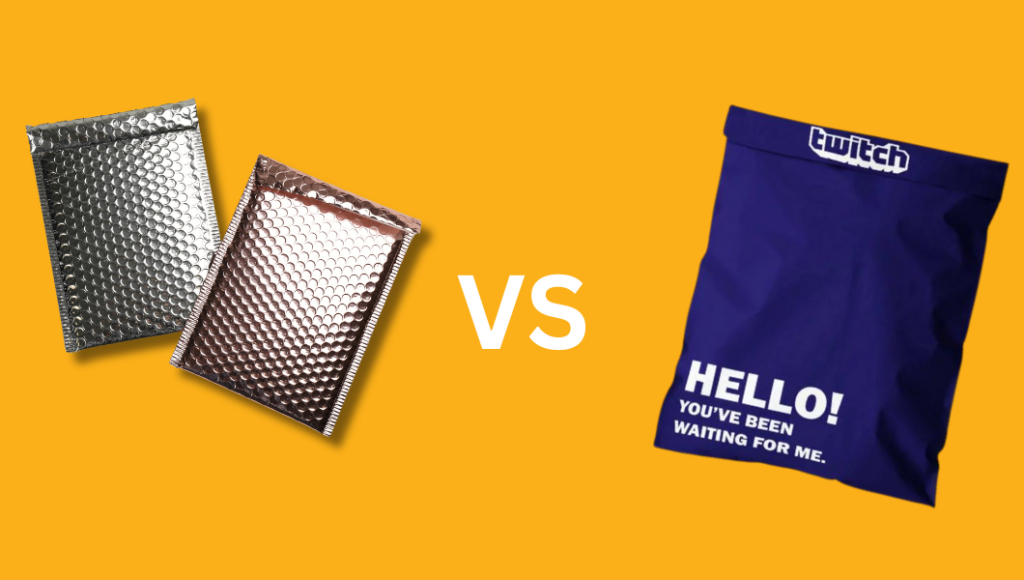
They sit next to each other on the shelf, they both seal without tape, and plenty of sellers treat them as interchangeable. They aren’t. The difference between a poly mailer and a bubble mailer is structural, and that structure decides two things that matter to your business: whether your product arrives intact, and what you pay to ship it.
This guide compares poly mailers and bubble mailers the way a buyer actually needs to see it. You’ll get clear definitions, a side-by-side table, sizing for both formats, real cost ranges with a worked postage example, the greener alternatives worth knowing about, and a simple rule for choosing.
What Is a Poly Mailer?
A poly mailer is a flat, flexible envelope made from co-extruded polyethylene film. It has a peel-and-press self-seal strip and no padding at all. What you get is a tough, lightweight, water-resistant skin around your product. Nothing more, nothing less.
That simplicity is the point. With no cushioning to add weight or bulk, a poly mailer is the lightest and cheapest way to ship anything soft. Fabric compresses, it doesn’t break, so it doesn’t need a buffer between it and the sorting belt. It just needs to stay dry and contained, which is exactly what a poly mailer does.
Best for: clothing, textiles, soft accessories, books, and documents. Not for: anything fragile, rigid, or sharp-cornered.
What Is a Bubble Mailer?
A bubble mailer is an envelope lined with a layer of air-bubble cushioning. The exterior can be either plastic (a poly bubble mailer, sometimes called a poly air jacket) or kraft paper, and both types have the same plastic bubble lining inside. Like poly mailers, they close with a self-seal strip.
That bubble layer is what you’re paying for. It cushions small items against the bumps and drops of transit, which makes bubble mailers the right call for products that can scratch, dent, or take a knock. The trade-off is weight, bulk, and cost, since you’re now shipping the padding along with the product.
Best for: cosmetics, jewelry, small electronics accessories, hardware, and other small semi-fragile goods. Not for: heavy items, or anything so fragile or rigid that it really belongs in a box.
Poly Mailers vs. Bubble Mailers: Side by Side
| Feature | Poly Mailer | Bubble Mailer |
| Construction | Flat polyethylene film, no padding | Poly or kraft exterior with a plastic bubble lining |
| Protection | Tear and moisture resistant, no cushioning | Cushioned against impact and scratches |
| Weight | Lightest | Heavier, adds padding weight |
| Best for | Soft, non-fragile goods | Small, semi-fragile goods |
| Unit cost | Lowest | Higher |
| Shipping cost | Lower, less billable weight | Higher, extra ounces |
| Recycling | Store drop-off (thin film) | Harder; mixed materials |
| Branding | Prints well across the full surface | Prints well, especially on kraft |
| Reusable | Not usually | Often, with a double seal strip |
The table settles the easy calls. What it can’t show is the money, which lives in two numbers: weight and unit price. Those come next.
What Size Do You Need?
Sizing is where most sellers quietly lose money. The instinct is to grab the next size up to be safe, but an oversized mailer adds bulk without adding protection, and in a poly mailer it adds ounces that can push a parcel into a higher weight bracket. Aim for a snug fit with just enough room to seal.
Poly mailers come in straightforward flat dimensions:| Poly Mailer Size (approx.) | Fits |
| 6″ x 9″ | Jewelry, socks, small accessories |
| 9″ x 12″ | One folded t-shirt, a light top |
| 10″ x 13″ | One to two tees, a folded dress |
| 12″ x 15″ | Hoodies, sweaters, thicker knitwear |
| 14.5″ x 19″ | Jeans, outerwear, multi-item orders |
Bubble mailers use a standard numbered sizing system, which is worth knowing when you order:
| Bubble Mailer Size | Dimensions (approx.) | Fits |
| #000 | 4″ x 8″ | Jewelry, USB drives, small parts |
| #0 | 6″ x 10″ | Cosmetics, small electronics accessories |
| #1 | 7.25″ x 12″ | Paperbacks, small boxed items |
| #2 | 8.5″ x 12″ | Books, a tablet in a sleeve |
| #4 | 9.5″ x 14.5″ | Small apparel with fragile trim |
| #5 | 10.5″ x 16″ | Larger or multiple items |
| #7 | 14.25″ x 20″ | Bigger semi-fragile goods |
Whichever format you choose, measure your product and add an inch or two on each side for thickness and sealing. When you’re unsure, order samples before you commit to a full run.
Why the Weight Difference Matters (The Real Cost)
Here’s the part few sellers actually run the numbers on. Carriers bill on weight, and a bubble mailer’s padding adds real ounces. A poly mailer in a common size weighs well under an ounce. A comparable bubble mailer often weighs two to three times as much. That sounds trivial until a parcel is sitting right at a carrier weight break.
Walk through a simple example. Say you ship 300 orders a month. Your bubble mailer weighs about 1.5 ounces and a same-size poly mailer weighs about 0.6 ounces, a difference of roughly an ounce. If around half of those shipments sit near a USPS weight threshold, that extra ounce bumps them into the next tier and adds somewhere around $0.40 per affected package. That’s roughly $60 a month, or over $700 a year, in surcharges you never see on an invoice line. Scale that across a growing operation and the number gets uncomfortable fast.
Unit price points the same direction. At volume, a custom poly mailer can run $0.08 to $0.25, while a custom bubble mailer typically lands $0.30 to $0.65. So a bubble mailer usually costs more to buy and more to ship. That’s fine when the product needs the protection, and wasteful when it doesn’t. For a full breakdown of packaging pricing by format and volume, see our packaging cost guide.
One practical note on classification: USPS treats anything over a quarter inch thick as a package, not an envelope. A stuffed bubble mailer often crosses that line, so pick the right parcel type at checkout to avoid a billing adjustment later.
When to Use a Poly Mailer
Choose a poly mailer when:
- You’re shipping soft, non-fragile goods like apparel, textiles, or soft accessories.
- The item compresses and has no rigid edges or breakable parts.
- Keeping weight and cost down is the priority, especially at higher volumes.
- You want a clean, printable surface for branding without paying box prices.
Apparel is the obvious fit. A folded shirt in a printed poly mailer ships light, packs fast, and still looks branded. If you run a clothing label, our guide to custom mailing bags for fashion brands goes deeper, and the packaging for clothing brandshub pulls the full kit together.
When to Use a Bubble Mailer
Choose a bubble mailer when:
- You’re shipping small items that can scratch or dent, like cosmetics, jewelry, or electronics accessories.
- The product has hard corners or a surface that needs a buffer against whatever’s stacked on top of it in a bin.
- A small amount of cushioning is enough, so you don’t need a full box and separate void fill.
There’s a limit, though. If an item is genuinely fragile, rigid, or heavy, like glassware, ceramics, or a hardback book, a bubble mailer isn’t enough. Those belong in a right-sized shipping box, ideally with molded pulp inserts for protection. Our guide on poly mailers vs. boxes covers where that line falls.
Greener Alternatives: Paper Padded and Compostable Mailers
If the only reason you’re reaching for a bubble mailer is protection, it’s worth knowing that the standard poly bubble mailer is one of the harder packaging types to recycle. The plastic bubble lining, and the mix of paper and plastic in kraft bubble mailers, means most curbside programs won’t take them, so they end up in store drop-off bins or the trash.
There are two cushioned alternatives that recycle much more easily:
- Paper padded mailers: padded with paper rather than plastic bubbles, and accepted by curbside recycling in most areas. They’re a bit heavier than a poly bubble mailer, but the end-of-life story is far cleaner, which matters to a growing share of shoppers.
- Compostable mailers: plant-based film that breaks down where composting is available, for brands that want a clear sustainability position.
And if a second look at your product tells you it doesn’t really need cushioning at all, a plain poly mailer or a curbside-recyclable paper mailer is lighter and cheaper than any padded option. To weigh the greenest choice for your product, our eco-friendly packaging range and sustainability consulting team can help.
How to Decide
Ask three quick questions about the product:
- Does it break, scratch, or dent? If no, use a poly mailer. If yes, keep going.
- Is a little cushioning enough, or is it truly fragile? A little cushioning means a bubble or paper padded mailer. Truly fragile or rigid means a box.
- Does sustainability lead your brand? If so, favor a paper padded or compostable mailer over a poly bubble one.
Quick verdict:
- Poly mailer for soft, non-fragile goods where cost and weight lead.
- Bubble mailer for small, semi-fragile items that need light cushioning.
- Paper padded or compostable mailer when you want protection with curbside recyclability.
- A box when the item is fragile, rigid, or heavy.
Common Questions About Poly and Bubble Mailers
Are poly mailers or bubble mailers cheaper? Poly mailers, on both counts. They cost less per unit (roughly $0.08 to $0.25 at volume versus $0.30 to $0.65 for bubble mailers) and less to ship, because they weigh less. Bubble mailers are only worth the premium when the product needs cushioning.
Which is better for shipping clothes? A poly mailer. Clothing is soft and non-fragile, so it doesn’t need padding, and the lighter poly mailer keeps both packaging and shipping costs down.
Can you ship fragile items in a poly mailer? No. Poly mailers have no cushioning, so fragile or breakable items need a bubble mailer, a paper padded mailer, or a box for anything truly delicate.
Are bubble mailers recyclable? Not easily. The plastic bubble lining, and the paper-plus-plastic mix in kraft bubble mailers, means most curbside programs reject them. For a recyclable cushioned option, choose paper padded mailers or compostable mailers.
What’s the difference between a bubble mailer and a padded mailer? A bubble mailer is cushioned with a plastic air-bubble lining. A paper padded mailer is cushioned with paper instead, which makes it curbside recyclable and a better fit for sustainability-focused brands.
Do bubble mailers cost more to ship? Yes. The padding adds weight, and near a carrier weight threshold that extra ounce or two can push a parcel into a higher rate, adding up across your order volume.
Is a bubble mailer an envelope or a package? USPS classifies anything over a quarter inch thick as a package. A filled bubble mailer usually exceeds that, so select the package or thick-envelope type at checkout to avoid a billing adjustment.
Which should a small business keep on hand? Often both. Use poly mailers as your default for soft goods, and keep bubble mailers or paper padded mailers for the fragile items in your catalog.
The Bottom Line
Poly mailers and bubble mailers solve different problems. A poly mailer is the lightweight, low-cost choice for soft, non-fragile goods, and it wins on both unit price and shipping weight. A bubble mailer adds cushioning for small items that can scratch or dent, at a higher cost and weight. Match the format to the product, reserve boxes for what’s truly fragile, and consider a paper padded or compostable mailer when you want protection you can recycle.
Plus Packaging can help you choose and customize the right mailer for every product you ship. Browse custom poly mailers and custom bubble mailers, start with a free digital mockup, or get a quote.