

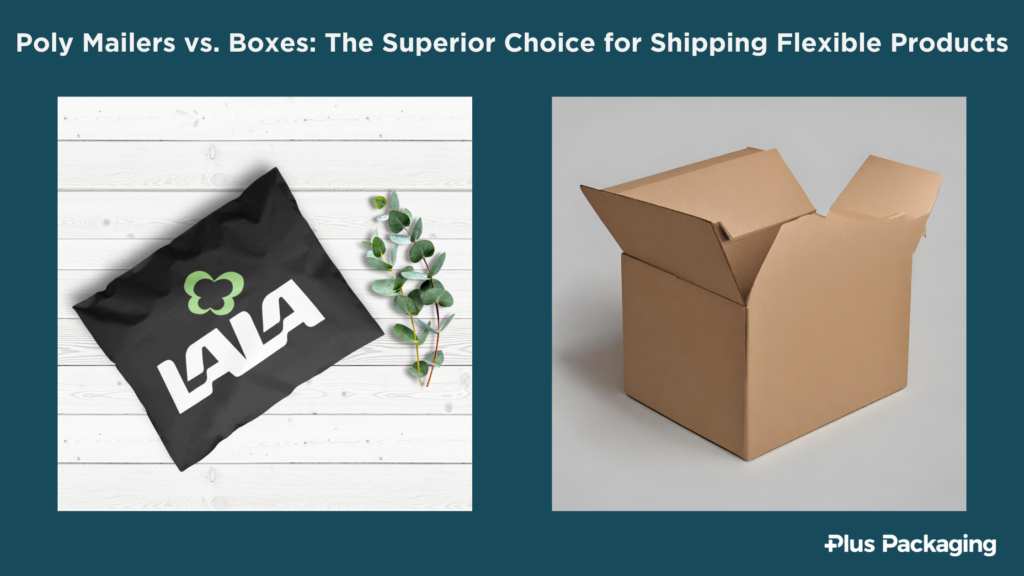
On paper, the answer looks obvious. A poly mailer costs a fraction of what a box costs, weighs almost nothing, and takes seconds to pack. So why do so many brands quietly switch back to boxes for half their catalog?
Because unit price is only one line in the real bill. The number that decides your shipping cost isn’t what you paid for the packaging, it’s the billable weight the carrier charges, plus what damage and returns cost you when the wrong product goes in the wrong pack. This guide compares poly mailers and shipping boxes on all three: unit price, shipping cost, and the hidden costs after delivery. You’ll get real ranges and a simple way to decide which one fits each product.
If you just want the verdict, jump to how to decide in 30 seconds. If you want to understand the money, start here.
What Is a Poly Mailer?
A poly mailer is a flexible shipping envelope made from polyethylene film, not cardboard. It has a built-in self-seal adhesive strip, so it closes without tape, and it’s lightweight, water-resistant, and tear-resistant. That combination is why poly mailers became the default for e-commerce apparel and soft goods.
What a poly mailer is good at:
- Low weight: it adds almost nothing to the parcel, which keeps shipping cost down.
- Fast packing: open, insert, peel, seal, done.
- Flat storage: thousands of them take up a shelf, not a pallet.
- Easy branding: the smooth film prints well, so custom poly mailers work for branded unboxing without a box.
Best for: clothing, textiles, accessories, and other soft, non-fragile items. If you run an apparel label, our packaging for clothing brands guide walks through the full kit.
What Is a Shipping Box?
A shipping box is made from corrugated board: two flat liners with a fluted, wavy layer glued between them. That flute is what gives a box its strength and cushioning. Boxes come in single, double, or triple wall depending on how much protection and stacking strength you need, and they seal with packing tape.
One quick clarification, since the terms get mixed up constantly. “Cardboard” is a loose word people use for everything. The board in a shipping box is technically corrugated, while the thinner paperboard in a cereal box or a folding carton is a different material. When strength matters, you want corrugated.
What a box is good at:
- Structural protection: the corrugated walls absorb compression and impact.
- Fragile and heavy items: it holds shape under stacking pressure.
- Multi-item orders: several products ship together without shifting.
- Premium unboxing: a custom mailer box or gift box creates a moment a flat mailer can’t.
Best for: fragile, heavy, or high-value goods, and any order where presentation is part of the product.
Poly Mailers vs. Boxes at a Glance
Here’s the honest side-by-side, corrected and expanded.
| Feature | Poly Mailer | Shipping Box |
| Material | Polyethylene film | Corrugated board |
| Sealing | Self-seal adhesive, no tape | Requires packing tape |
| Protection | Light, flexible, no structure | Rigid, absorbs impact and compression |
| Best for | Soft, light, non-fragile items | Fragile, heavy, or bulky items |
| Unit cost | Lowest | Higher |
| Shipping weight | Very low, less dimensional weight | Higher, more dimensional weight |
| Branding | Prints well, one flat surface | Full print, inserts, layered unboxing |
| Packing speed | Fastest | Slower, needs assembly |
| Storage | Flat, minimal space | Bulky, more space |
| Recycling | Store drop-off (thin film) | Curbside in most areas |
A single table can’t make the call for you, though, because the two costs that matter most are not in it: what the carrier bills, and what failure costs. Those come next.
How Much Do Poly Mailers and Boxes Actually Cost?
Start with the sticker price. These are directional 2026 ranges for custom printed packaging. Your real number depends on size, board grade, print, finishes, and order size. For an exact quote on your specs, request pricing or read our full packaging cost guide, which breaks down every format by volume.
| Format | Low Volume (500 to 1,000) | High Volume (10,000+) |
| Poly mailers | $0.25 to $0.55 | $0.08 to $0.25 |
| Paper mailers | $0.35 to $0.75 | $0.15 to $0.35 |
| Bubble mailers | $0.55 to $1.20 | $0.30 to $0.65 |
| Compostable mailers | $0.45 to $0.95 | $0.20 to $0.45 |
| Paper padded mailers | $0.60 to $1.30 | $0.30 to $0.70 |
| Corrugated shipping boxes | $2.50 to $6.00 | $1.00 to $2.50 |
The pattern is clear. At volume, a poly mailer can run under $0.25, while a comparable box rarely drops below a dollar. On packaging alone, a mailer is often four to ten times cheaper per unit. If that were the whole story, you’d move everything to mailers tomorrow. It isn’t.
Why Unit Price Is Only Half the Story
The bigger lever on most parcels is dimensional weight, and it’s the part buyers overlook.
Carriers like UPS, FedEx, and USPS bill you on the greater of two numbers: the actual weight and the dimensional (or volumetric) weight. Dimensional weight turns the size of your parcel into a weight, using a simple formula:
Dimensional weight = (Length x Width x Height) ÷ DIM divisor
Common divisors are around 139 for UPS and FedEx ground, and about 166 for many USPS services. The bigger and boxier your parcel, the higher that number climbs, even if the product inside is light.
Here’s what that does in practice. Say you’re shipping a folded hoodie that actually weighs about 1.5 pounds.
- In a 12 x 10 x 4 inch box: that’s 480 cubic inches. Divided by 139, the dimensional weight is about 3.5 pounds, which rounds up to 4 pounds billable. The carrier charges you for 4 pounds, not 1.5.
- In a 12 x 15 inch poly mailer: packed nearly flat, the parcel has very little volume, so it bills on its actual weight, roughly 2 pounds.
Same hoodie, same distance. The box ships at 4 billable pounds and the mailer at 2. Across a zone or two of ground shipping, that gap is often a few dollars per parcel, and it repeats on every single order. For a store shipping thousands of soft-goods orders a month, moving the right SKUs into poly mailers can save more on postage than it saves on packaging.
This is the real reason mailers win for apparel and accessories. Not because the envelope is cheap, but because it barely registers on the scale.
The Hidden Costs: Damage, Returns, and Reputation
There’s a flip side, and it’s where brands lose money by pushing mailers too far.
A poly mailer offers no structural protection. Put something fragile, sharp-cornered, or breakable inside, and the savings can vanish through damage, returns, and support tickets. The math is unforgiving because these costs multiply across your whole order volume.
Picture a store shipping 10,000 orders a month, weighing a switch from box to mailer on a soft-goods line:
- Switching saves roughly $2.00 per order across packaging and postage, so about $20,000 saved per month.
- If the mailer raises the damage and return rate by just 1 percent, that’s 100 more failed orders. At around $25 each once you count the replacement product, reshipping, support time, and reverse logistics, that’s $2,500 in new cost. Net, you’re still well ahead.
- But if the product is fragile and damage jumps 5 percent, that’s $12,500 in new cost, which eats most of the savings and leaves you with unhappy customers on top.
Damaged deliveries also do quiet reputational damage. A parcel that arrives creased, crushed, or dented reads as careless, even when the product is fine, and that shows up in reviews and repeat purchase rates. For higher-value items, a box signals care in a way a thin mailer can’t.
The takeaway isn’t “boxes are safer, use boxes.” It’s that the right answer depends on the product, and getting it wrong in either direction costs money. Our packaging engineering team runs exactly this analysis: matching format to product so you capture the savings without the damage.
When to Choose a Poly Mailer
Reach for a poly mailer when:
- The product is soft, flexible, or compressible, like apparel, textiles, or soft accessories.
- It has no rigid edges or fragile parts that concentrate pressure on the seams.
- Weight is low and evenly spread.
- You’re shipping one or two small items and a box would just add empty space.
- Speed and storage efficiency matter, which they do for high-volume e-commerce fulfillment.
Apparel is the textbook case. A folded shirt in a printed mailer ships light, packs fast, and still looks branded, especially with a sheet of tissue paper inside.
When to Choose a Box
Reach for a shipping box when:
- The product is fragile, breakable, or has hard corners, like glassware, electronics, or ceramics.
- It’s heavy or dense enough to strain a mailer’s seams.
- You’re combining several items in one order.
- Presentation is part of the product and you want a real unboxing moment, which is where a mailer box, gift box, or magnetic box earns its higher cost.
- The item ships long distance through multiple sorting facilities, where handling and stacking pressure add up.
For fragile goods, pairing a right-sized box with molded pulp inserts protects the product without resorting to plastic foam.
Beyond Poly: Which Mailer Type Beats a Box?
Here’s what most comparisons miss. “Mailer” doesn’t mean only poly. There’s a whole family of mailers, and several of them cover situations where you might assume you need a box. Knowing the options can move more of your catalog out of expensive boxes without adding risk.
- Poly mailers: the cheapest and lightest, best for soft, non-fragile goods at volume.
- Paper mailers: a curbside-recyclable, plastic-free option with a premium paper feel, ideal for apparel brands that want to drop plastic without moving to a box.
- Bubble mailers: built-in cushioning for small items with some fragility, like cosmetics or hardware, often replacing a box plus void fill.
- Compostable mailers: certified compostable film for sustainability-led brands that want the mailer format and a clean end-of-life story.
- Paper padded mailers: protection plus curbside recyclability, a strong middle ground when a poly mailer feels too flimsy but a box feels like overkill.
A useful way to think about it: if you’re only considering a box because of fragility, a bubble mailer or paper padded mailer often does the job for less, with lower dimensional weight. If you’re considering a box for sustainability reasons, a paper mailer or compostable mailer gives you a plastic-free story and still ships flat. The box wins on rigidity and premium unboxing, but for a lot of products, the right mailer captures most of the benefit at a fraction of the shipping cost.
What About Sustainability?
Sustainability is now part of the decision, not a side note. Consumer research has repeatedly found that a large share of shoppers prefer, and will even pay more for, products in sustainable packaging, so the format you choose affects brand perception as well as cost.
The comparison isn’t as simple as “plastic bad, paper good.” A few honest points:
- Boxes use more material. A box takes more fiber and more space in a truck than a mailer, which raises both material use and transport emissions. Right-sizing matters as much as material choice.
- Poly mailers are light but harder to recycle. They’re thin-film plastic, which usually means store drop-off rather than curbside, though recycled-content options reduce their footprint.
- Paper-based mailers recycle curbside. Paper mailers and paper padded mailers go in with regular paper recycling in most areas.
- Compostable mailers close the loop where composting is available, which is why compostable mailers suit brands making a specific end-of-life promise.
If sustainability is central to your brand, our eco-friendly packaging range and sustainability consulting can map the lowest-impact option that still protects the product and holds your budget.
The Smart Play: Use Both
The best-run operations rarely pick one format for everything. They segment their catalog by risk and assign packaging to match:
- Soft, low-risk products go in mailers, usually poly or paper.
- Fragile, heavy, or premium products go in boxes, with protective inserts where needed.
- Anything in between gets a cushioned mailer, bubble or padded.
This hybrid approach controls cost, keeps damage rates low, and protects the customer experience across your whole range. A prebuilt custom kit can bundle the formats you use most, and our cost reduction service can audit your current mix to find where you’re overpacking or underprotecting.