

If you’re shipping something that absolutely cannot arrive bent, dented, or crushed, the choice between a rigid mailer and a bubble mailer isn’t a small detail, it’s the difference between a happy customer and a return request. Both are built to protect products in transit, but they protect against completely different kinds of damage. Here’s how to tell which one your product actually needs.
The Quick Answer
Use a rigid mailer when your product needs to stay perfectly flat and can’t survive being bent, folded, or creased, think documents, photos, trading cards, and artwork. Use a bubble mailer when your product needs cushioning against impact, drops, and vibration, think small electronics, jewelry, cosmetics, and anything with a hard or breakable surface. The core distinction is bend resistance versus shock absorption, and most shipping damage falls clearly into one category or the other.
What Is a Rigid Mailer?
A rigid mailer is a flat, stiffened mailer built from paperboard or corrugated material, designed to resist bending during transit. It has little to no cushioning inside. Its entire job is structural: keep the contents flat, no matter how the package gets handled, stacked, or squeezed in a mail truck.
Rigid mailers are the standard choice for:
- Documents and legal paperwork
- Photographs and prints
- Trading cards and collectibles
- Certificates and diplomas
- Artwork and flat prints
- Vinyl records
What a rigid mailer won’t do is protect against a drop or a hard impact. There’s no shock absorption built into the design, so if your product is fragile in a way that goes beyond “must stay flat,” a rigid mailer alone isn’t enough protection.
What Is a Bubble Mailer?
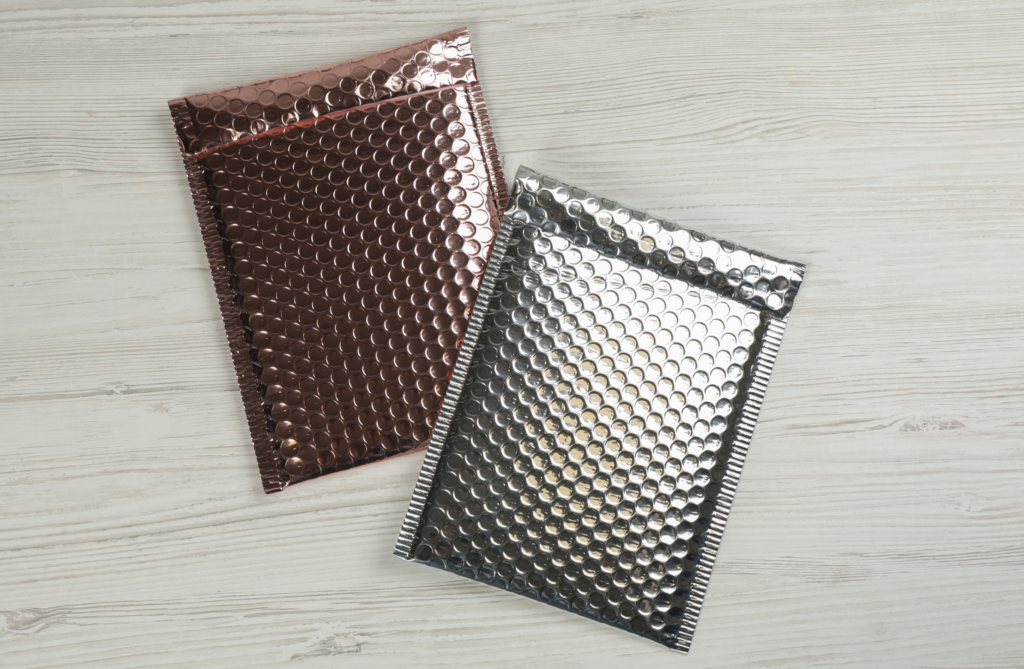
A bubble mailer is a padded shipping mailer with a bubble cushioning layer built into the interior, wrapped in a durable outer shell that’s usually poly film or kraft paper. Its job is the opposite of a rigid mailer: absorb shock and vibration so the product inside survives drops, rough sorting equipment, and getting tossed around in transit.
Custom Bubble Mailers are the go-to choice for:
- Small electronics and accessories
- Jewelry
- Cosmetics and glass containers
- DVDs, media, and small retail goods
- Any product with a hard edge or breakable component
If you want that same shock protection without a plastic bubble lining, Custom Paper Padded Mailers use a paper-based honeycomb or crinkle fill instead, giving you comparable cushioning while keeping the mailer fully recyclable as one material.
Rigid Mailer vs Bubble Mailer: Side-by-Side Comparison
| Factor | Rigid Mailer | Bubble Mailer |
| Protection type | Bend and crease resistance | Impact and shock absorption |
| Structure | Flat, stiff paperboard or corrugated | Flexible, padded interior |
| Best for | Flat, rigid items | Items with hard edges or fragile components |
| Weight | Lightweight to moderate | Slightly heavier due to padding |
| Shipping cost | Generally lower, ships closer to flat-rate | Moderate, depends on padding thickness |
| Common materials | Chipboard, corrugated cardboard | Poly film with bubble lining, or paper with padded fill |
| Recyclability | Recyclable through standard paper/cardboard streams | Depends on material; look for mono-material or paper-based options |
When to Choose a Rigid Mailer
The test for a rigid mailer is simple: would bending the product damage it? If a photo gets creased, a trading card gets a corner ding, or a document gets folded in a way that matters, rigidity is the priority, not cushioning. Rigid mailers keep the product locked flat between two firm panels, which is exactly what these categories need and exactly what a padded mailer, which flexes by design, can’t reliably guarantee.
Rigid mailers also tend to be lighter and cheaper to ship than padded alternatives, since they don’t carry the extra weight of a bubble or padded lining. For high-volume flat-item shipping, like a print shop or a trading card seller, that adds up fast.
When to Choose a Bubble Mailer
The test for a bubble mailer is different: would an impact or drop damage the product? Anything with a hard, breakable, or delicate component, glass, ceramics, electronics, jewelry with small parts, needs cushioning that absorbs shock, not just a stiff outer shell. A rigid mailer would keep that same item flat, but it does nothing to soften a drop from a delivery truck onto a porch.
Bubble Mailers solve this with a padded interior that flexes on impact and absorbs the shock before it reaches the product. If you’re trying to reduce plastic in your packaging without giving up that protection, Paper Padded Mailers deliver the same cushioning function using a paper-based fill instead of a bubble film lining.
What About Products That Need Both?
Some products genuinely need bend resistance and shock absorption at the same time, think framed prints, vinyl records, or layered documents with a rigid backing. In these cases, many sellers combine approaches: a rigid insert placed inside a padded mailer, giving the product a stiff backing plus a cushioned shell around it. This isn’t an either-or decision if your product’s risk profile demands both types of protection.
For lighter-weight items that just need basic surface protection without either extreme, a standard Custom Poly Mailer or Custom Paper Mailer may be all that’s needed, no padding or rigid backing required. It’s worth stepping back and asking whether your product actually needs the extra material and cost of a rigid or padded format at all.
Cost Comparison
Rigid mailers are usually the more budget-friendly option per unit, since they use a single layer of stiff material rather than a padded, multi-layer construction. They’re also lighter, which keeps postal costs down for high-volume flat shipments.
Bubble mailers cost more due to the padding layer, but that cost is easy to justify when the alternative is a broken product, a return, and a refund. Custom Paper Padded Mailers sit in a similar price range to standard Custom Bubble Mailers, so the deciding factor between the two usually comes down to whether you want a plastic-free option rather than cost alone.
Sustainability Considerations
Rigid mailers made from paperboard or corrugated material are typically recyclable through standard curbside cardboard and paper streams, making them one of the more straightforward packaging formats to dispose of correctly.
Bubble mailers are more complicated, since a plastic bubble lining combined with a different outer material can be hard for sorting facilities to separate. If sustainability is a priority, look for bubble mailers built from a single recyclable material, or choose Paper Padded Mailers, which keep the whole mailer, shell and padding, in one recyclable paper family. Brands looking to avoid plastic packaging altogether across their whole lineup might also consider Compostable Mailers for non-fragile items, or Paper Mailers for anything that doesn’t need padding at all.
Frequently Asked Questions
Can a rigid mailer protect a fragile item? Only against bending, not against impact. If the item is fragile in the sense that it could break from being dropped, a rigid mailer alone won’t protect it. Pair it with padding, or use a Bubble Mailer instead.
Is a bubble mailer stiff enough to prevent bending? Not reliably. Bubble mailers flex by design, which is what gives them their shock-absorbing property, but that same flexibility means they can’t guarantee a flat, crease-free result the way a rigid mailer can.
Which is cheaper, rigid or bubble mailers? Rigid mailers are generally less expensive per unit and lighter to ship, since they don’t include a padded layer. Bubble mailers and Paper Padded Mailers cost more due to the added cushioning material.
What’s the more eco-friendly choice? Rigid paperboard mailers are usually easier to recycle since they’re a single material. For padded protection with the same recyclability advantage, Paper Padded Mailers are a stronger choice than a standard plastic-lined bubble mailer.
Final Thoughts
Rigid mailers and bubble mailers solve two different shipping problems. If your product needs to stay flat, a rigid mailer wins every time. If your product needs to survive a drop, a Custom Bubble Mailer or a plastic-free Custom Paper Padded Mailer is the right call. And if your product doesn’t need either level of protection, a simple Custom Poly Mailer or Custom Paper Mailer will save you money without sacrificing anything your product actually needs. Match the mailer to the risk, not the other way around.