

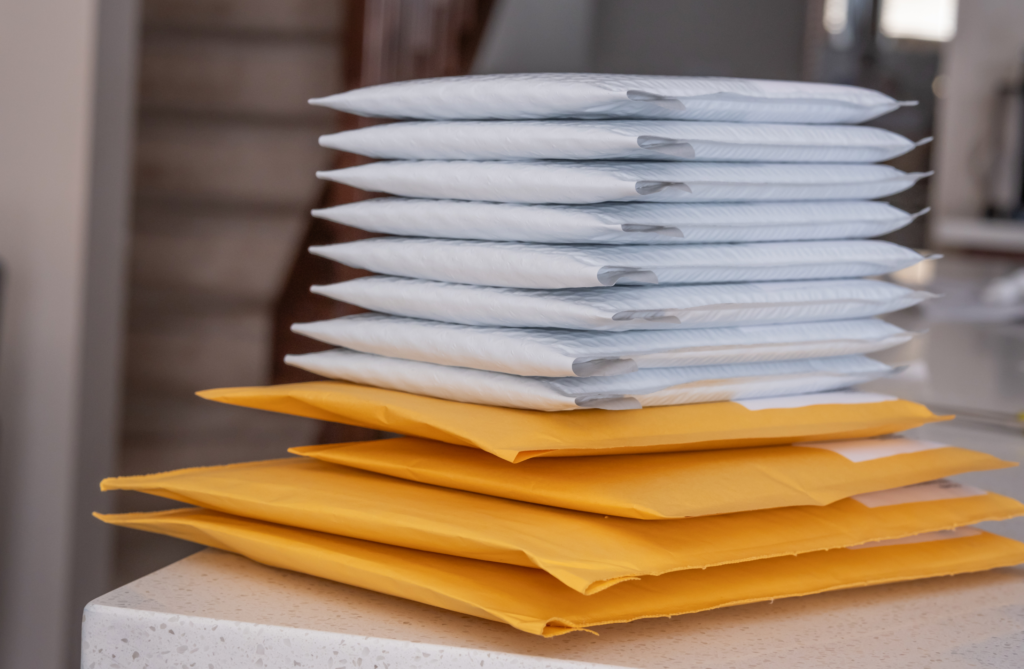
Both kraft and poly bubble mailers do the same basic job: they wrap a product in cushioning and get it through the mail in one piece. Past that, they’re built from completely different materials, and that difference shows up in how they handle moisture, how much they weigh, what they signal to a customer before the package is even opened, and where they end up after the customer is done with them.
Picking between the two isn’t really a matter of which one is “better.” It’s a matter of which one matches your product, your shipping conditions, and what you want the unboxing moment to say about your brand. This guide breaks down exactly where each one wins.
What Are Kraft Bubble Mailers?
A kraft bubble mailer has a paper exterior, usually made from kraft paper, the same tough, unbleached material used in grocery bags, wrapped around a layer of bubble cushioning on the inside. The paper gives it a rigid, structured feel that lies flat and resists bending, while the bubble lining underneath handles the actual cushioning job.
That structure makes kraft bubble mailers a strong fit for anything flat or semi-rigid: books, printed materials, photos, small boxed goods, or gift certificates. The paper exterior also takes ink and adhesive labels cleanly, and its natural, unbleached look reads as a sustainability signal on its own, before a customer even opens the package.
What Are Poly Bubble Mailers?
A poly bubble mailer swaps the paper shell for polyethylene film, wrapped around the same kind of bubble cushioning inside. Where kraft is rigid, poly is flexible: it stretches and molds around the shape of whatever’s inside rather than staying a fixed shape. That flexibility, combined with a naturally water-resistant surface, is why poly has become the default choice for apparel, cosmetics, electronics accessories, and just about anything shipped at real e-commerce volume.
Poly bubble mailers can also be fully custom printed edge to edge, which turns the whole mailer into brand real estate rather than a plain shipping bag with a label stuck on the front.
Kraft vs Poly Bubble Mailers: Head-to-Head Comparison
| Feature | Kraft Bubble Mailers | Poly Bubble Mailers |
| Exterior material | Kraft paper | Polyethylene film |
| Structure | Rigid, holds its shape | Flexible, molds to contents |
| Moisture resistance | Low, absorbs water | High, repels water |
| Weight | Slightly heavier | Lighter |
| Tear resistance | Good, can crease or dent | Excellent, stretches rather than tears |
| Best for | Books, flat items, printed materials | Apparel, soft goods, high-volume shipping |
| Recyclability | Curbside recyclable in most areas | Requires plastic film drop-off, unless recycled/compostable content |
| Branding surface | Excellent for print, natural texture reads as eco-friendly | Smooth surface, vibrant full-color printing |
Durability and Protection: Which Holds Up Better?
Neither material is objectively tougher. They’re built to protect different things.
Poly wins on raw resilience. Polyethylene film stretches under pressure instead of tearing outright, which means it shrugs off rough handling, compression, and the kind of careless tossing that happens somewhere in every shipping route. For anything soft, flexible, or irregularly shaped, apparel especially, that flexibility is an advantage, not a weakness.
Kraft wins on rigidity. The paper shell keeps flat items from bending or creasing, which matters for books, documents, and anything that needs to stay perfectly flat to avoid damage. Kraft doesn’t stretch the way poly does, but for the products it’s built to protect, it doesn’t need to.
The simple rule: if your product can be damaged by bending, kraft is the safer call. If it can be damaged by rough handling or getting wet, poly is the better fit.
Moisture Resistance: Where the Real Difference Shows Up
This is the single biggest functional difference between the two materials. Poly is naturally water-resistant, so a package left on a porch in the rain or delayed in a humid warehouse arrives just as protected as it left. Kraft paper absorbs moisture. A soaked kraft mailer can weaken, tear, or let water reach whatever’s inside, which is a real risk for any shipping route with unpredictable weather.
If your product would be ruined by getting wet in transit, that alone often settles the decision in favor of poly, regardless of what else matters to your brand.
Sustainability and End-of-Life: What Happens After the Customer Opens It
This is where the two materials diverge the most, and where it’s worth being precise rather than making a blanket claim either way.
Kraft bubble mailers, especially those made with post-consumer recycled content, are curbside recyclable in most municipal systems. A customer pulls the product out and drops the mailer in with their cardboard, no special drop-off point required. That’s the simplest possible end-of-life story a packaging format can offer.
Poly bubble mailers made from conventional plastic don’t have that same curbside pathway. Most municipal recycling systems can’t process plastic film, since it tangles sorting equipment, so it needs a dedicated plastic film drop-off point instead. That said, this isn’t the full picture anymore. Recycled poly mailers, made from post-consumer plastic waste, and compostable mailers, built from PLA or PBAT blends that break down under real composting conditions, both give brands a genuine alternative to virgin plastic without giving up poly’s durability and water resistance. Our guide to sustainable packaging materials goes deeper into which of these options actually deliver on their environmental claims.
The honest takeaway: kraft has the more accessible disposal path, full stop. Poly can close a lot of that gap with recycled or compostable versions, but only if the claim on the bag matches infrastructure your customers actually have access to.
Cost and Shipping Weight
Per-unit material cost is usually close between the two, and the bigger cost driver is almost always order volume and customization complexity rather than kraft versus poly itself.
Where it does matter is weight, at scale. Kraft bubble mailers typically weigh a bit more per unit than an equivalent poly bubble mailer, since paper is inherently heavier than thin polyethylene film. For most orders, that difference is too small to matter. It becomes real money when you’re shipping thousands of units a month and a meaningful share of your packages sit right at a carrier’s weight-tier cutoff, where even a fraction of an ounce can bump a shipment into a more expensive rate bracket. If you’re shipping high volume and watching postage closely, it’s worth asking your packaging supplier for the exact per-unit weight of both formats and running the math against your specific carrier’s rate tiers rather than assuming the difference doesn’t matter.
Branding and Customer Perception
Kraft communicates something before a customer even opens the package. The natural, unbleached paper texture reads as an intentional, eco-conscious choice, which works especially well for brands in books, beauty, food, and lifestyle categories where the unboxing moment is part of the product experience.
Poly gives you more room to play with color and print. Its smooth surface reproduces bold, full-color designs more vibrantly and consistently than paper does, which is why fashion, streetwear, and other visually driven D2C brands tend to lean toward poly. A fully custom-printed poly mailer turns an ordinary shipment into something a customer might actually photograph.
Neither format has a monopoly on good branding. The real question is what you want the package to communicate before it’s even opened, natural and sustainable, or bold and graphic.
Which One Should You Choose?
| Your situation | Best pick | Why |
| Shipping books, documents, or flat rigid items | Kraft | Structured form prevents bending, curbside recyclable |
| Shipping apparel, soft goods, or textiles | Poly | Flexible, moisture-resistant, lighter |
| Shipping through humid or rainy regions | Poly | Repels water; kraft absorbs it |
| Sustainability-forward brand wanting the simplest disposal story | Kraft, or a custom compostable mailer | Curbside recyclable with no drop-off needed, or a genuine compostable alternative |
| High volume shipping where weight affects postage tier | Poly | Lighter per unit, adds up at scale |
| Bold, full-color branding on every shipment | Poly | Smoother print surface, more vibrant color |
| Natural, minimalist brand aesthetic | Kraft, via a custom paper padded mailer | Natural texture signals sustainability on its own |
| Shipping small, unpadded items like documents or apparel accessories | Custom paper mailer or standard custom poly mailer | Padding isn’t needed; a lighter, unpadded format cuts cost |
Frequently Asked Questions
Are kraft or poly bubble mailers cheaper?
Per-unit cost is usually close between the two at similar order volumes. The bigger cost factors are order size, printing complexity, and any added features like tamper-evident seals, not the base material itself.
Can poly bubble mailers be recycled?
Conventional poly needs a plastic film drop-off point rather than curbside recycling. Recycled poly mailers made from post-consumer plastic, and fully compostable poly mailers, both offer a more sustainable end-of-life path if that matters to your brand.
Are kraft bubble mailers waterproof?
No. Kraft paper absorbs moisture rather than repelling it, so kraft bubble mailers aren’t a good fit for shipping routes with significant rain or humidity exposure.
Which one is better for shipping clothing?
Poly bubble mailers, in almost every case. They’re lighter, flex around folded garments without adding bulk, and resist moisture damage in a way kraft can’t.
Can I get both kraft and poly bubble mailers custom printed?
Yes. Both formats support full custom branding, kraft through natural paper printing and poly through vibrant full-color designs across a smooth plastic surface.
Final Thoughts
Poly bubble mailers win on durability against rough handling, moisture resistance, weight, and vibrant full-color branding. Kraft bubble mailers win on structure for flat items, straightforward curbside recyclability, and a natural aesthetic that signals sustainability without saying a word.
Most brands don’t have to pick one and stick with it forever. It’s common to stock custom bubble mailers for apparel and soft goods, and custom paper padded mailers for books, gifts, or anything where a natural, structured package fits the brand better. If sustainability is the deciding factor either way, it’s worth comparing both against a custom compostable mailer, which can offer poly’s durability with a genuinely different end-of-life story.
Not sure which format fits your product? Plus Packaging can help you compare samples side by side before you commit to a full production run.