

Quick answer: For single paperbacks, a poly mailer is the cheapest option that still blocks moisture. For hardcovers, textbooks, and anything with resale value, a bubble mailer or corrugated bookfold mailer protects corners best. For plastic-free brands, padded paper mailers or compostable mailers are the closest eco alternatives, and multi-book orders usually do better in a rigid mailer box.
Books are one of the trickiest categories to package. They’re dense for their size, they have sharp corners that punch through weak materials, and even light moisture can permanently warp a cover or ripple a page block. At the same time, books don’t need the crush protection that glassware or electronics do — their own weight and rigidity does a lot of the work. That combination is exactly why so many sellers get book packaging wrong: either overspending on a full box they don’t need, or underspending on a flimsy bag that lets corners bend and covers scuff.
This guide covers every mailer type that actually holds up for books, how to size and pack them correctly, what USPS Media Mail means for your shipping costs, and the mistakes that cause most of the damage claims and 1-star reviews in the book resale and publishing world.
What Books Actually Need From Packaging
Before comparing mailer types, it helps to know exactly what you’re protecting against. For books, the real risks in transit are:
- Corner and spine damage from being tossed around with heavier packages at a sorting facility
- Moisture damage — even light rain, condensation, or humidity can warp pages or ripple a cover
- Bent covers, especially on paperbacks, if the mailer is too loose and the book shifts or gets compressed under other packages
- Scuffed or scratched covers, particularly on glossy hardcovers or dust jackets, from friction against the inside of the mailer
- Crushed spines, common when a book is packed with too much empty space and something heavier lands on top
Notice that heavy crush protection isn’t really the priority. Books are rigid enough on their own that thick padding is often overkill and just adds cost and dimensional weight. What actually matters is corner rigidity, a snug fit, and keeping moisture out.
The 7 Mailer Types Compared
1. Poly Mailers — Fast and Cost-Effective, With One Catch
Custom Poly Mailers are the go-to for paperbacks and softcover books because they’re lightweight, fully waterproof, and cheap to ship in bulk. The polyethylene shell blocks rain and humidity completely, which solves the single biggest risk for books in transit.
The catch is corner protection. A standard poly mailer has zero rigidity, so a hardcover or a stack of paperbacks can still take corner dings if the bag isn’t sized correctly or gets stacked under something heavy. Poly mailers work best for single paperbacks, softcover books, magazines, comics (bagged with a board), and lighter print materials where a bent corner isn’t a dealbreaker.
Best for: single paperbacks, softcovers, magazines, low-value used books Skip if: shipping hardcovers, first editions, or anything with resale value
2. Bubble Mailers — The Standard for Hardcovers and Valuable Books
For hardcovers, textbooks, art books, or anything with resale or collector value, Bubble Mailers are the more reliable choice. The bubble lining cushions corners and edges — exactly where books get damaged most often — and the poly exterior gives you moisture resistance and impact protection in the same package.
This makes bubble mailers the default option for:
- Hardcover books and textbooks
- Signed copies, first editions, or collectible books
- Art books, cookbooks, and titles with heavier paper stock or glossy covers
- Multi-book bundles where extra weight increases the risk of shifting and corner impact
The added padding costs a bit more per unit than a plain poly mailer, but for anything with resale value, it’s usually worth it to avoid damage claims and negative reviews over a bent corner.
Best for: hardcovers, textbooks, collectibles, bundles Watch for: sizing too loose — padding doesn’t help if the book can still slide and hit a seam
3. Paper Mailers — A Traditional, Book-Friendly Option
Many independent bookstores and small publishers prefer Paper Mailers, and it’s not just about looks. Kraft paper has more structure than thin poly film, which offers modest extra resistance to bending compared to an unpadded poly bag, plus a classic, literary feel that fits indie booksellers well.
The tradeoff is moisture. Paper mailers don’t handle rain or humidity nearly as well as poly, so they work best for sellers in drier climates, sellers who add a plastic outer layer, or shipments handled primarily by carriers with reliable indoor sorting.
Best for: branded indie bookstore/publisher shipments, drier climates Skip if: you ship through humid regions or during rainy seasons without extra protection
4. Padded Paper Mailers — Cushioning Without the Plastic
If your business wants to avoid plastic packaging but still needs corner protection, Paper Padded Mailers are the middle ground. Instead of an air-bubble lining, they use crumpled or layered recycled paper fiber as padding — cushioning corners reasonably well while staying fully paper-based and curbside recyclable in most municipalities.
They’re solid for hardcovers and moderately valuable books where some cushioning matters but a plastic bubble mailer doesn’t fit your sustainability positioning. They won’t match the water resistance of a poly-backed bubble mailer, so pair them with a protective inner sleeve on longer or wetter routes.
Best for: hardcovers with plastic-free packaging goals Watch for: rain and high-humidity shipping lanes
5. Compostable Mailers — For Eco-Focused Publishers and Sellers
Independent publishers and used-book resellers increasingly build sustainability into their brand, and Compostable Mailers fit that positioning well. They break down under industrial composting conditions, which resonates with environmentally conscious buyers who care about what happens to packaging after the box is opened.
They tend to work best for lighter, less fragile books like paperbacks, since compostable materials generally offer less structural rigidity than poly or bubble-lined options. For anything with sharp corners or resale value, pair a compostable mailer with an internal cardboard corner protector rather than relying on the bag alone.
Best for: paperbacks, eco-first brands, used-book resellers Watch for: limited rigidity; add a chipboard insert for anything valuable
6. Rigid & Stay-Flat Mailers — Zero Bend, Zero Fold
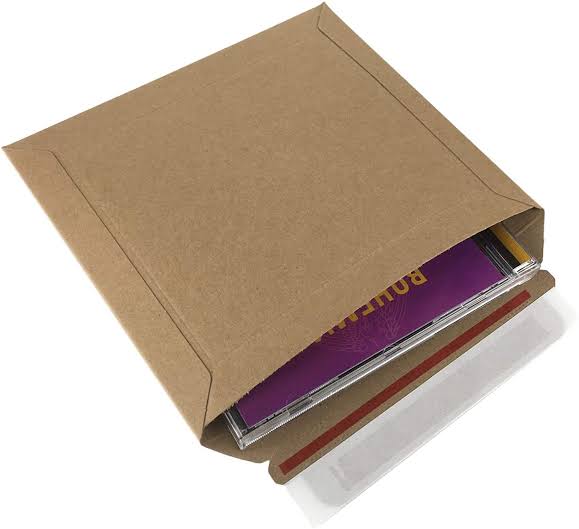
Rigid mailers use a stiff paperboard or laminated panel construction specifically designed to never bend, making them a strong option for thin books, comics, art prints tucked in with a book, signed bookplates, or anything where a crease would ruin the item. They’re less common for thicker hardcovers since they don’t flex to fit variable depths, but for slim paperbacks, graphic novels, and journals shipped flat, they outperform a standard poly or paper mailer on presentation and corner rigidity.
Best for: thin paperbacks, comics, journals, anything that must stay perfectly flat Watch for: not ideal for thicker or multi-book shipments — they’re built for depth, not volume
7. Corrugated Bookfold / Adjustable-Depth Mailers — Built Specifically for Books
This is the category most sellers overlook, and it’s worth knowing about even if you end up choosing something else: corrugated bookfold mailers are one-piece cardboard mailers scored at multiple depths so a single size can wrap securely around books of varying thickness. They fold around the book like a self-contained box, seal with tape, and give full 360-degree corner and edge protection without the bulk or cost of a rigid outer box.
For sellers shipping a mix of paperback and hardcover formats — or heavier hardcovers and textbooks that a bubble mailer can’t fully protect — a bookfold-style mailer or a compact Custom Mailer Box is often the better call. It’s the closest thing to a purpose-built book box without ordering a separate size for every format.
Best for: mixed formats, heavier hardcovers, textbooks, high-value or signed editions Watch for: higher unit cost than a bag-style mailer, and it adds a bit more dimensional weight
Quick Comparison: Which Mailer Fits Your Books?
| Mailer Type | Best for | Corner Protection | Water Resistance |
| Custom Poly Mailers | Single paperbacks, softcovers, magazines | Low | High |
| Bubble Mailers | Hardcovers, textbooks, collectible or bundled books | High | Moderate to high |
| Paper Mailers | Independent bookstores, budget-friendly shipping | Moderate | High |
| Paper Padded Mailers | Hardcovers with plastic-free packaging goals | Moderate to high | Low to moderate |
| Compostable Mailers | Paperbacks, eco-focused publishers and sellers | Low to moderate | Moderate |
How to Size a Mailer for Books
Books are far less forgiving of sizing mistakes than soft goods like apparel, since there’s no give in the product. A few rules of thumb:
- Measure the book at its exact dimensions, including the spine width for hardcovers and thicker paperbacks.
- Add minimal clearance — generally under half an inch on each side. Too much slack lets the book slide and increases the chance of corner impact against the mailer’s own seams.
- Use a rigid inner layer for multi-book orders, like a sheet of chipboard between books, especially when stacking hardcovers.
- Standardize around 2–3 sizes if you sell a range of formats: one for mass-market paperbacks, one for trade paperbacks, and one for hardcovers/textbooks.
- Weigh the finished package, not just the book, before choosing a shipping service — packaging weight affects your Media Mail or Ground Advantage cost more than people expect.
Corner Protection: The Detail Most Sellers Skip
Even with the right mailer, corners remain the single most common point of damage for books in transit. A few extra steps make a real difference:
- Add a chipboard or cardboard sheet cut slightly larger than the book and placed behind it inside the mailer, to add rigidity without switching to a full box.
- Wrap the book itself in a thin layer of tissue, kraft paper, or a plastic sleeve before placing it in the mailer — this reduces surface scuffing independently of corner impact.
- Avoid mailers that are noticeably larger than the book. Extra room is one of the most common causes of corner and cover damage, because it gives the book space to shift and collide with the seams during handling.
- Tape all seams, not just the opening — bookfold and paper mailers can flex open at the corners under pressure if only the main flap is sealed.
- Mark “Do Not Bend” on paper-based mailers for handmade, signed, or one-off items; it won’t guarantee gentler handling, but it does reduce careless stacking in most facilities.
Shipping Cost: Why USPS Media Mail Matters as Much as the Mailer
Packaging choice and shipping cost are connected more than most sellers realize, because USPS Media Mail is a weight-based, distance-independent rate built specifically for books — and it’s usually far cheaper than standard parcel services.
- Media Mail pricing starts around $4.47 for the first pound, with roughly $0.75 per additional pound, up to a 70-lb maximum, per USPS Notice 123 (rates are updated periodically, so confirm current pricing at usps.com before quoting customers).
- Because Media Mail is priced by weight only, not distance, a heavy textbook costs the same to ship across the country as it does across town — a major advantage over Ground Advantage or Priority Mail, which price by zone.
- To qualify, a package must contain only eligible educational/media content — books with at least 8 pages, printed music, playscripts, and similar materials — with no promotional inserts, advertising, or non-media merchandise mixed in. USPS can inspect Media Mail packages, and non-qualifying contents can trigger postage-due charges.
- Because dimensional weight matters, an oversized mailer with unused space can bump you into a higher shipping tier even if the book itself is light. This is another reason correctly sized packaging — not just protective packaging — saves money.
- Media Mail is slower than other services (roughly 2–10 business days) and doesn’t include default insurance, so it’s a better fit for standard resale and backlist shipments than for guaranteed next-day or high-value collector sales, where Priority Mail with insurance is worth the extra cost.
Common Mistakes That Cause Damaged Books
- Using a bag that’s too big. Extra room lets the book shift and collide with seams — the #1 cause of bent corners.
- Relying on padding instead of fit. A loose bubble mailer still lets a book move; a snug plain mailer with a chipboard insert often performs better.
- Skipping moisture protection in humid regions. Paper and compostable mailers look premium but can wick moisture in wet climates without a plastic outer layer or careful route planning.
- Mixing promotional inserts into Media Mail shipments. This is a compliance issue, not just a packaging one — it can trigger inspection and additional postage.
- Not testing the actual material against a real book. Spec sheets and marketing copy don’t always reflect how a bag performs against a sharp 90-degree corner; a physical sample catches this before a 500-unit order doesn’t.
What to Ask Before Ordering in Bulk
If you’re moving from single orders to bulk packaging for a bookstore, publisher, or reseller business, ask your supplier:
- Does the mailer come in book-friendly stock sizes, or will you need a custom size for mass-market paperback, trade paperback, or hardcover formats?
- What’s the minimum order for custom branded runs, and is there a lower-cost stock option while you’re testing demand?
- Can you request a physical sample to test the material against a real book’s corners before committing to a large order?
- Is the material recyclable, compostable, or made from recycled content — and can that be verified rather than just marketed?
- What’s the production and shipping lead time, particularly ahead of gift-buying seasons when book sales spike?
- Can the supplier support multiple SKUs (e.g., poly for paperbacks, bubble for hardcovers) under one account so you’re not managing separate vendors for each format?
Frequently Asked Questions
What is the best mailer for shipping a book? For a single paperback, a poly mailer is the most cost-effective option that still blocks moisture. For hardcovers, textbooks, or collectible editions, a bubble mailer or corrugated bookfold mailer gives better corner protection.
Can I use a regular envelope to ship a book? Standard paper envelopes generally aren’t rigid or padded enough to protect corners and can tear under a book’s weight. A purpose-built paper or poly mailer designed for the book’s dimensions performs far better.
Do books need bubble wrap inside the mailer? Usually not. Books rarely need crush protection — what they need is corner rigidity and a snug fit. A chipboard insert or a properly sized bubble mailer typically outperforms loose bubble wrap.
What size mailer should I use for a paperback vs. a hardcover? Measure the book’s exact height, width, and spine thickness, then add less than half an inch of clearance. Most sellers standardize on one size for mass-market paperbacks and a larger size for trade paperbacks and hardcovers.
Is USPS Media Mail safe for shipping books? Yes — Media Mail is designed specifically for books and other educational materials and is the cheapest USPS option by weight. Just make sure the package contains only qualifying content, since mixed shipments with promotional materials can be reclassified.
Are poly mailers bad for hardcover books? Poly mailers are fine for hardcovers on short, low-risk routes, but they don’t cushion corners, so a bubble mailer or bookfold-style mailer is the safer choice for anything with resale or collector value.
Final Thoughts
For most booksellers, the choice comes down to value and format. Lighter, less valuable paperbacks ship well in Poly Mailers, where moisture resistance matters more than cushioning. Hardcovers, textbooks, and anything with resale or collector value are better protected in Bubble Mailers or a corrugated bookfold-style Mailer Box, where corner cushioning prevents the most common type of damage. If your brand leans traditional or budget-conscious, Paper Mailers offer a classic feel at a lower cost, and if sustainability is central to your business, Paper Padded Mailers and Compostable Mailers let you ship books without relying on plastic.
Get the corners protected, keep moisture out, size the mailer to the book rather than the other way around, and match your shipping service to the package weight. That combination is most of what separates a book that arrives in perfect condition from one that shows up with a bent cover and an unhappy customer.