

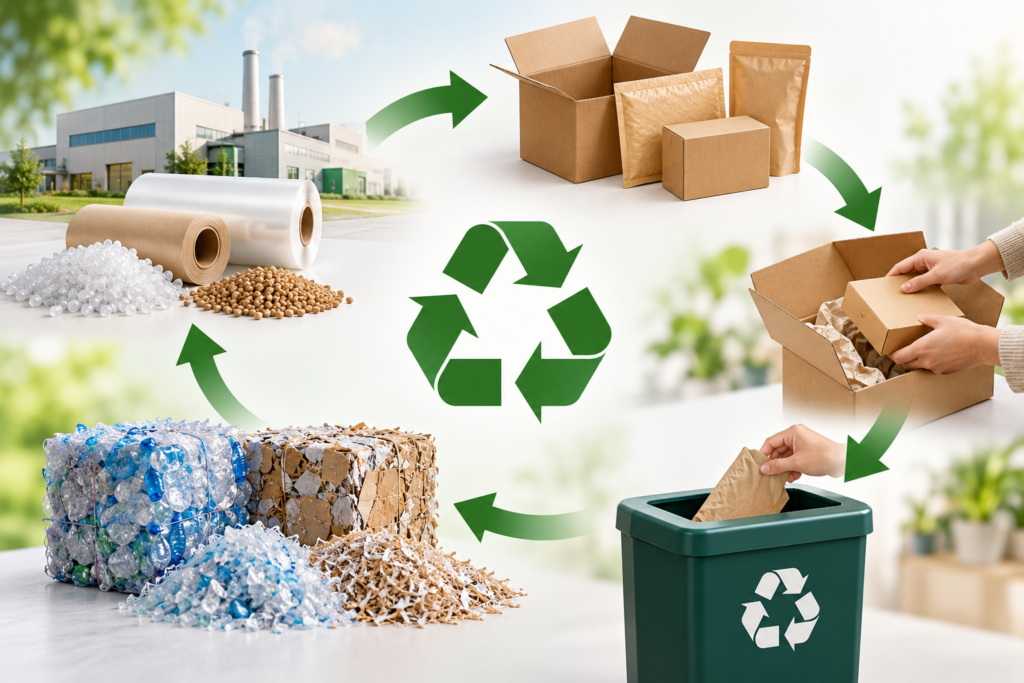
If you sell physical products, there’s a good chance EPR rules already apply to you, or will soon. Extended Producer Responsibility (EPR) is reshaping how businesses think about packaging, and it’s no longer a niche regulatory topic limited to a handful of countries. States and countries are rolling out EPR laws for packaging at a steady pace, and the materials you choose to ship your products in are now directly tied to compliance costs and reporting requirements.
This guide explains what EPR packaging actually means, why it matters for anyone shipping products, and how to choose packaging materials that keep you ahead of the requirements rather than scrambling to catch up.
What EPR Actually Means
Extended Producer Responsibility is a policy approach that shifts the cost and responsibility for a product’s end-of-life disposal onto the producer rather than leaving it entirely to local governments and taxpayers. For packaging specifically, this means the business that puts a product into the market, not just the manufacturer of the packaging material, can be held responsible for how that packaging gets collected, recycled, or disposed of after a customer is done with it.
In practice, EPR packaging laws usually require businesses to:
- Report the type and volume of packaging materials they use each year
- Pay fees based on that packaging’s weight, material type, and recyclability
- Meet minimum recycled content thresholds in certain materials
- Design packaging that can realistically be recycled or composted in existing municipal systems
The fee structure is often the part that catches sellers off guard. Materials that are harder to recycle, like certain multi-layer plastics, typically carry higher EPR fees than materials with established recycling infrastructure, like paper or certain single-material plastics.
Where EPR Packaging Laws Are Already in Effect
EPR for packaging isn’t hypothetical. Several U.S. states, including Oregon, Colorado, California, Maine, and Minnesota, have passed EPR packaging laws with phased implementation timelines running through the mid-2020s and beyond. Globally, EPR packaging frameworks have been in place for years in parts of the European Union and Canada, often with more mature reporting systems than what’s currently rolling out in the U.S.
Even if your business isn’t currently based in a state with an active EPR law, selling into one of these states can still trigger reporting obligations. That’s an important detail for e-commerce sellers in particular, since a single online store can easily ship into multiple EPR states without the business being physically located in any of them.
Why Packaging Material Choice Matters More Than Ever
Because EPR fees are typically tied to material type and recyclability, the packaging you choose now has a direct line to future compliance costs. This changes the calculation for a lot of sellers who previously picked packaging based mostly on cost and durability. A cheap material that happens to be difficult to recycle can end up costing more over time once EPR fees are factored in.
This is where the growing shift toward paper-based and compostable shipping materials starts to make more financial sense, not just an environmental one.
Lower-Impact Mailer Options Worth Considering
A few packaging categories tend to perform better under EPR frameworks, either because they’re made from widely recyclable materials or because they break down without needing specialized recycling infrastructure:
Paper-based mailers. Paper Mailers are made from a material with well-established recycling systems in most regions, which generally puts them in a lower fee tier under most EPR structures compared to multi-layer plastic alternatives. For sellers shipping lighter, flatter products, switching to a paper mailer can reduce both environmental impact and projected compliance costs.
Compostable mailers. Compostable Mailers are built from plant-based materials designed to break down without leaving microplastics behind, which positions them well as EPR frameworks increasingly reward packaging that avoids landfill and recycling-stream contamination altogether. For brands that want to get ahead of tightening material standards rather than just reacting to them, compostable mailers are one of the more future-proof choices currently available.
Paper padded mailers. For sellers who need cushioning but want to avoid a plastic bubble lining, Paper Padded Mailers offer a middle ground that keeps the packaging largely paper-based while still protecting fragile or semi-fragile items. This matters under EPR because mixed-material packaging is sometimes assessed differently than single-material packaging, and a mostly-paper mailer with minimal padding typically fares better than a fully plastic-lined one.
Bubble mailers. Bubble Mailers still have a place for genuinely fragile products, and EPR compliance doesn’t mean abandoning materials that protect your product properly. The key is using them where the cushioning is actually necessary, rather than defaulting to bubble mailers for every order regardless of fragility. Overusing a higher-fee material for products that don’t need that level of protection adds unnecessary cost on both the shipping and compliance side.
Poly mailers. Custom Poly Mailers remain a practical option for durability and weatherproofing, and many EPR programs are structured around recycled content percentages rather than banning plastic outright. Choosing poly mailers made with a higher percentage of post-consumer recycled content can help keep fees lower while still getting the tear resistance and moisture protection that soft goods and apparel sellers rely on.
A Practical Approach to EPR-Ready Packaging
Rather than overhauling every part of your packaging at once, most sellers find it easier to work through this in stages:
- Audit your current packaging mix. Note which materials you use most, by volume and by weight, since that’s generally how EPR fees get calculated.
- Identify your highest-fee materials. Multi-layer plastics and non-recyclable composites usually carry the steepest EPR costs. If a major share of your shipments use these, that’s the first place to look for an alternative.
- Match replacements to actual product needs. Don’t swap a bubble mailer for a paper mailer if the product genuinely needs cushioning. Instead, look at where you’re using heavier-duty materials for products that don’t require them.
- Check recycled content percentages with your supplier. If you’re sticking with poly mailers for certain product lines, ask what percentage of recycled content is used, since this can directly affect your fee tier under several state programs.
- Keep records as you go. EPR reporting requirements typically ask for packaging data by material type and weight, so tracking this as you order materials saves a scramble when reporting deadlines come up.
EPR Isn’t Just a Compliance Issue
There’s a business case here beyond avoiding fees. Customers increasingly notice packaging choices, and a shift toward recyclable or compostable materials can be part of how a brand presents itself, not just a regulatory checkbox. Sellers who get ahead of EPR requirements now are also the ones least likely to face a sudden cost spike or a scramble to requalify packaging once enforcement ramps up in more states.
Final Thoughts
EPR packaging rules are changing how sellers need to think about shipping materials, shifting the decision away from cost and durability alone and toward recyclability, material composition, and long-term compliance exposure. For most sellers, this doesn’t mean abandoning materials that work, it means being more deliberate about which product lines actually need heavier packaging like bubble mailers versus which ones can move to lower-impact options like paper mailers, paper padded mailers, or compostable mailers. Where plastic still makes sense, choosing custom poly mailers with higher recycled content keeps that option viable without ignoring where EPR policy is heading.
Getting ahead of this now, rather than waiting for a reporting deadline or a fee notice, puts sellers in a much better position as more states bring their EPR packaging programs online.