

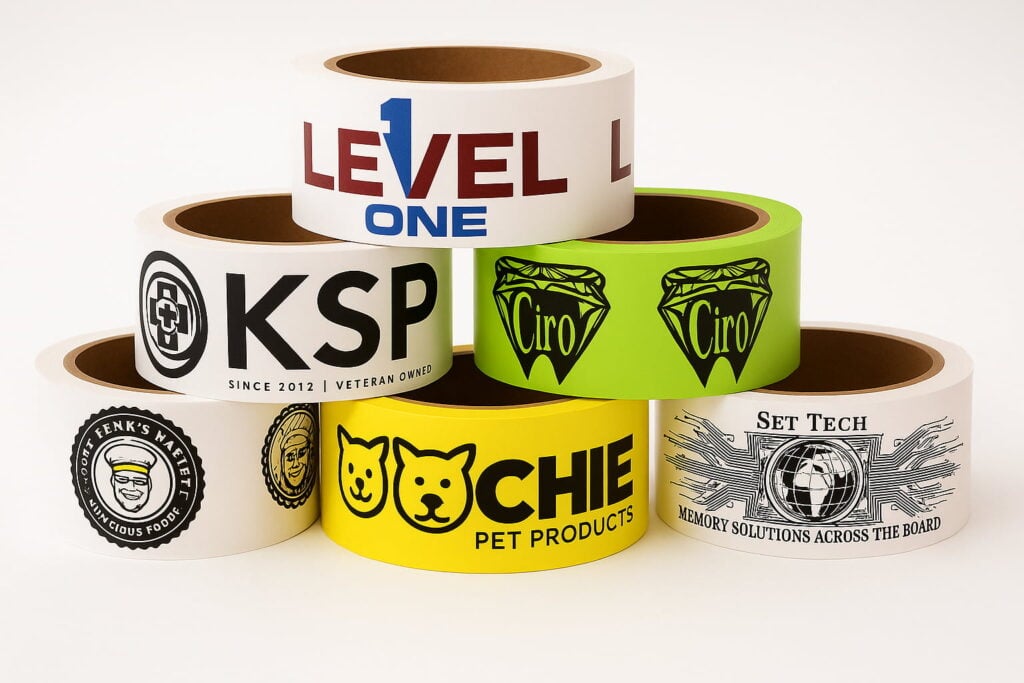
Quick answer: The best packaging tape for shipping depends on the job. For everyday e-commerce parcels, custom printed kraft tape is the top pick — it bonds permanently to cardboard, is tamper-evident, recyclable, and carries your brand. For heavy boxes (30 lb+), water-activated gummed tape is strongest. For general utility, clear carton sealing tape is cheapest. For cold or frozen shipments, use a cold-temperature acrylic tape. For pallets and reinforcement, choose filament tape.
Not all packaging tape is the same, and the wrong choice costs money. Tape that fails in cold conditions, wrong-gauge tape for heavy boxes, or plain tape on customer-facing parcels that could have carried your brand are all avoidable mistakes. This guide covers every major packaging tape type, how to match tape to your specific shipping situation, and what to look for in strength, thickness, adhesive type, and sustainability. If you’re building out a full system, it pairs naturally with the right shipping boxes and mailers.
Quick Comparison: All Packaging Tape Types (2026)
| Tape Type | Strength | Best For | Eco-Friendly? | Customizable? | Price Range | Where to Buy |
|---|---|---|---|---|---|---|
| Custom Printed Tape | ★★★★★ | Branding + security | Yes – paper-based | Yes – logos, colors, messages | $$-$$$ | Plus Packaging |
| Clear Carton Sealing Tape | ★★★☆☆ | Basic shipping | No – plastic | No | $ | Office supply stores |
| Water-Activated Gummed Tape | ★★★★★ | Heavy boxes | Yes – recyclable | Limited | $$-$$$ | Shipping suppliers |
| Heavy-Duty Moving Tape | ★★★★☆ | Storage & moving | No – plastic | No | $$ | Hardware stores |
| Filament Tape | ★★★★★ | Reinforcing heavy packages | No – plastic | No | $$ | Industrial suppliers |
| Masking Tape | ★☆☆☆☆ | Temporary labeling | Partially | No | $ | Everywhere |
1. Custom Printed Kraft Tape — Best for Branding + Security
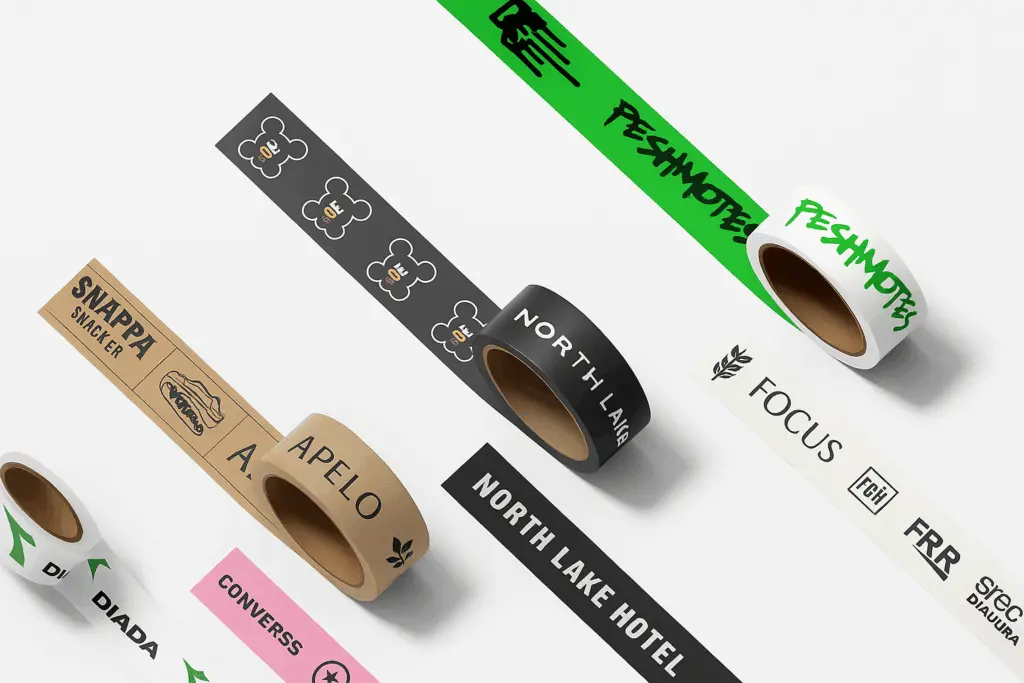
Custom printed tape has become the first choice for e-commerce businesses that care about both security and presentation. Unlike standard plastic tape, kraft tape forms a fiber-to-fiber bond with corrugated cardboard that actually strengthens as it dries. The result is a seal that cannot be removed and reapplied without obvious visible damage — a natural tamper-evident feature.
What sets custom printed tape apart in 2026 is print quality and accessibility. Full-color logos, URLs, QR codes, and seasonal messages can now be printed directly on kraft tape with sharp reproduction, and minimum order quantities have dropped significantly — making it viable for businesses shipping a few hundred packages a month, not just large-scale operations.
Why businesses choose custom printed tape
- Tamper-evident — the tape permanently bonds to cardboard and cannot be cleanly removed
- Eco-friendly — paper-based and recyclable with the cardboard box, no separation required
- Stronger bond — water-activated adhesive penetrates box fibers; one 3″ strip replaces multiple strips of plastic tape
- Brand visibility — every package becomes a branded touchpoint before it’s even opened
- Sustainability messaging — print eco credentials or recycling instructions directly on the tape
- Low minimums — available in quantities accessible to small businesses
Custom printed tape typically costs 2–3 cents more per foot than standard clear tape. For most e-commerce businesses, the branding benefit and the reduction in total tape used (one strip vs. multiple) offsets the price difference at shipping volumes above 300 packages per month. It also works as part of a complete branded system alongside custom mailer boxes and tissue paper — see our guide to the benefits of custom packaging for the full picture.
Best for: E-commerce brands, subscription box services, gift retailers, DTC brands, and any business where the unboxing experience is part of the customer relationship.
2. Clear Carton Sealing Tape — Best for General Purpose Shipping

Standard clear polypropylene tape remains the most widely used packaging tape for a reason: it’s inexpensive, works with any standard tape gun, and handles the majority of everyday shipping needs without setup. It’s the right choice for internal shipments, returns processing, and any parcel that doesn’t need to make a brand impression.
Pros
- Low cost — typically $2–5 per roll at retail, less at volume
- Widely available — any office supply or hardware store
- Works with standard 3″ core tape dispensers
- Transparent — doesn’t obscure labels or barcodes
- Available in 1.6 mil through 3.1 mil for different weight ranges
Cons
- Adhesive weakens in temperatures below 40°F or above 100°F
- Can be removed and reapplied without detection — not tamper-evident
- Plastic-based — must be removed before recycling cardboard
- Often requires multiple strips for secure sealing on heavy boxes
- No branding value
If using clear tape in a cold warehouse or for shipments to cold climates, switch to an acrylic-adhesive tape rather than hot-melt. Hot-melt adhesives can lose a substantial share of their bonding strength in freezing conditions.
Best for: Internal shipments, returns processing, lightweight packages (under 20 lb), and businesses where tape is a pure utility purchase.cessing, lightweight packages (under 20 lb), and businesses where tape is a pure utility purchase.
3. Water-Activated Gummed Tape — Best for Heavy Boxes + Sustainability
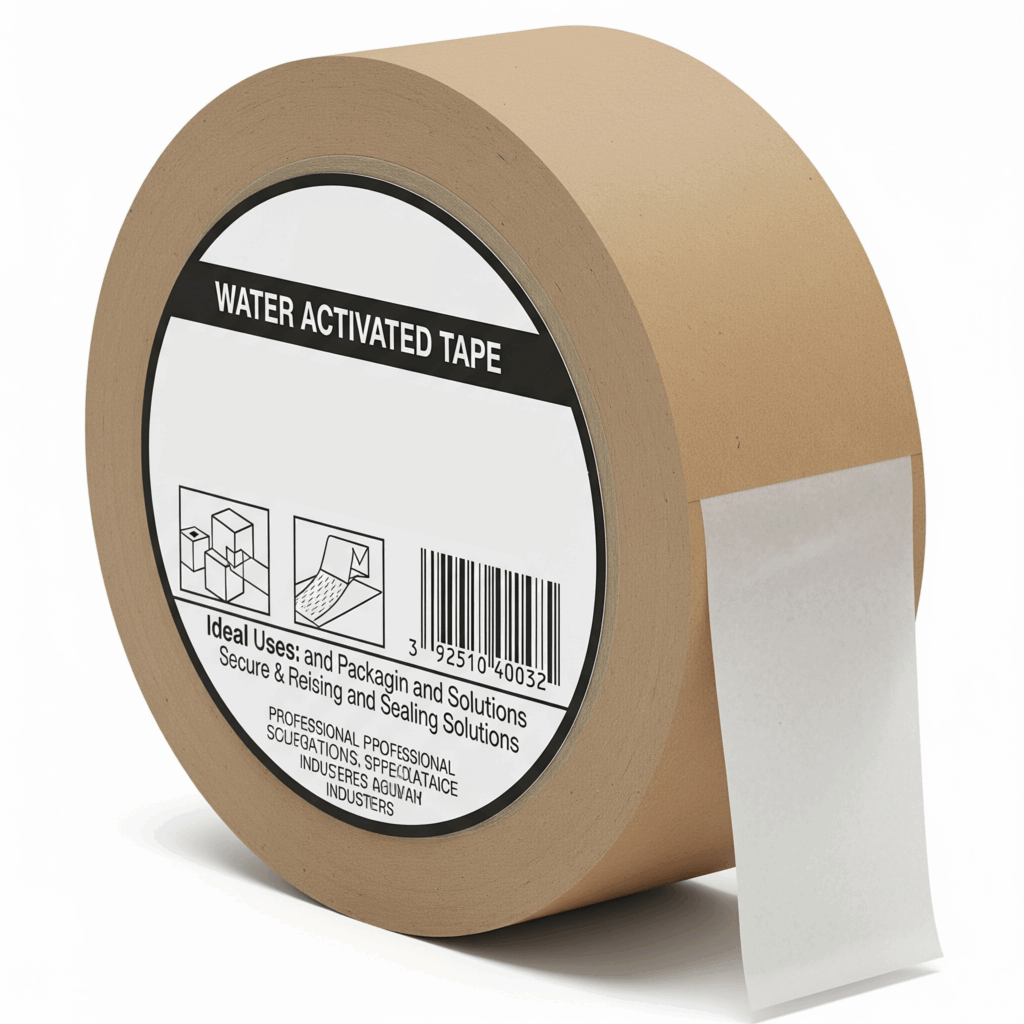
Water-activated tape (WAT), also called gummed tape, uses a starch-based adhesive activated by moisture. When applied, it creates a permanent mechanical bond with the corrugated fibers of the box itself — not just the surface. The box and tape essentially become one structure, which is fundamentally different from pressure-sensitive tapes that only bond to the surface.
Key advantages
- Permanent bond — cannot be cleanly removed once dry; tamper-evident by nature
- Exceptional strength — one 10″ strip replaces 24+ inches of plastic tape on a heavy box
- Works on recycled cardboard — bonds well even on rough or porous surfaces where plastic tape struggles
- Fully recyclable with the box — no separation needed
- Reduces tape consumption — often cutting the number of strips needed by half or more on heavy boxes
The investment required
WAT requires a dedicated dispenser to wet the tape as it’s dispensed. Manual dispensers start around $250; electric models run $500–$1,000+. For businesses shipping heavy or high-value items at any meaningful volume, the ROI is typically achieved within a few months through reduced tape usage and fewer damage claims. If you’re weighing that math, our cost-reduction service can model it against your volumes.
Reinforced WAT adds fiberglass strands through the tape for even higher tensile strength. Use reinforced tape for packages over 40 lb or items with hard edges that create stress points on the tape — or pair it with protective molded pulp packaging for fragile goods.
Best for: Warehouses and fulfillment centers shipping heavy items, businesses with sustainability commitments, high-value goods requiring tamper evidence, and recycled cardboard boxes where plastic tape adhesion is inconsistent.
4. Filament / Strapping Tape — Best for Reinforcing and Bundling
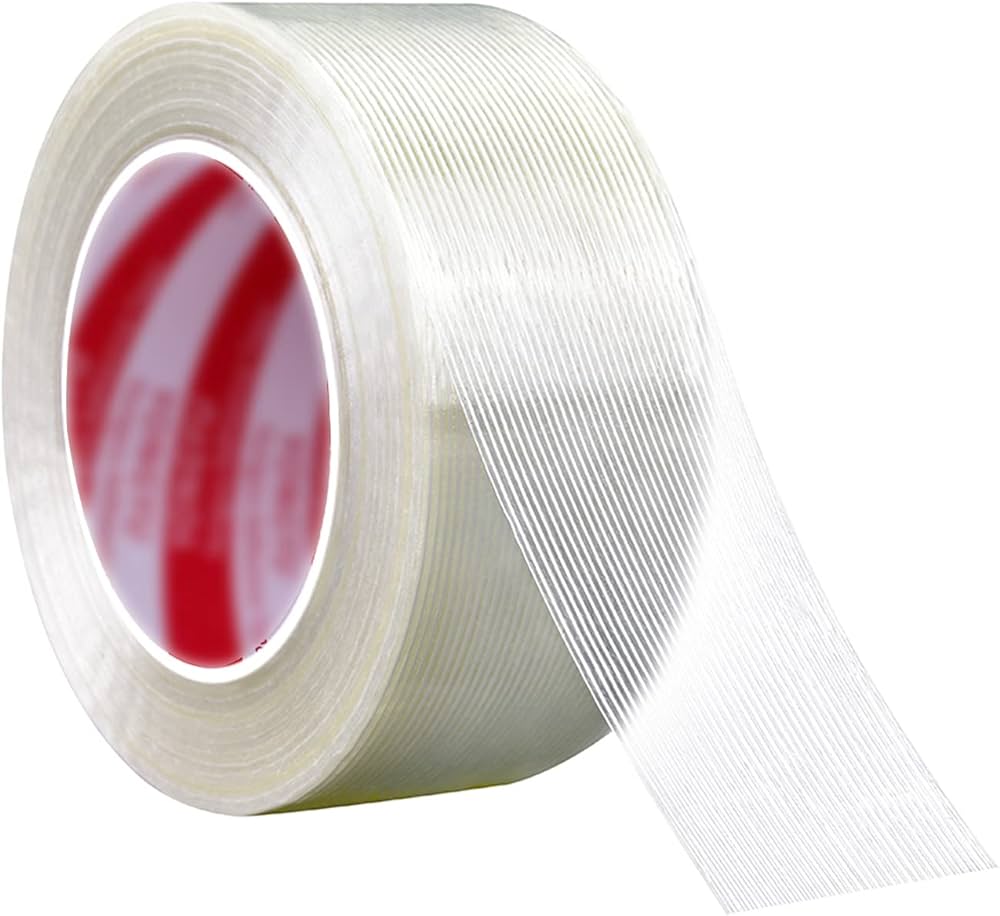
Filament tape contains fiberglass or polyester strands running the length of the tape, creating exceptional tensile strength in a thin profile. It’s not typically used as the primary box-sealing method, but it’s the best choice for reinforcing stress points, bundling irregular items, and securing products to pallets.
Key uses
- Reinforcing box corners and edges on heavy or awkward packages
- Bundling multiple boxes or items together
- Securing items to pallets alongside stretch wrap
- Strapping down oversized or irregularly shaped items for freight
- Temporary support for packages that will be further wrapped or palletized
Limitations
- Not suitable as the only seal on a box — gaps between strands allow ingress
- More expensive per roll than carton sealing tape
- Requires dedicated dispensers for efficient use at volume
- Not recyclable — fiberglass strands contaminate paper recycling
Best for: Logistics operations, furniture and appliance shippers, industrial distributors, and any application where reinforcement of specific stress points is the primary need.
5. Cold-Temperature Tape — Best for Refrigerated and Frozen Shipments
Standard hot-melt adhesive tapes lose significant bonding strength at low temperatures. Cold-temperature tapes use specially formulated acrylic or synthetic rubber adhesives engineered to bond reliably at temperatures from -20°F to 0°F, making them essential for food, pharmaceutical, and healthcare shipments.
When you need cold-temperature tape
- Sealing boxes in a refrigerated or freezer warehouse
- Shipping frozen or chilled food products
- Pharmaceutical cold-chain shipments
- Packages destined for cold-climate destinations in winter months
- Any application where boxes are sealed at ambient temperature but stored or shipped cold
If your packages are sealed at room temperature and only encounter cold during transit, a high-quality acrylic-adhesive carton sealing tape (rather than a specialist cold-temperature product) may be sufficient. Test a sample at your lowest expected temperature before committing to a full supply.
Best for: Food delivery businesses, healthcare distributors, cold-chain logistics operators, and any business shipping perishables — often alongside insulated shipping boxes.inesses, healthcare distributors, cold chain logistics operators, and any business shipping perishables.
6. Heavy-Duty Moving and Storage Tape
Moving tape is a reinforced pressure-sensitive tape designed for high-weight boxes (up to 80 lb per box on premium products) and long-term storage. The adhesive is typically a more aggressive hot-melt or acrylic formulation that maintains grip through temperature fluctuations and extended storage.
- Best for boxes being moved or stored — not for shipping through a carrier network
- Long-term storage tape (acrylic adhesive) holds through temperature extremes for 2–3 years
- Clear and tan versions available — tan is more resistant to UV degradation in bright storage
- Not tamper-evident and not branded — purely a functional product
Packaging Tape Thickness Guide
Tape thickness is measured in mils (thousandths of an inch). Thickness and adhesive strength together determine how much weight and handling a taped box can withstand. Use this reference when specifying tape for different product weights.
| Thickness | Category | Box Weight | Notes |
| 1.6–1.9 mil | Light-duty | Under 20 lb | Suitable for light packages and short-distance shipping only |
| 2.0–2.5 mil | Medium-duty | 20–40 lb | Standard for most e-commerce and retail shipping applications |
| 2.6–3.1 mil | Heavy-duty | 40–70 lb | Required for heavy boxes or rough handling environments |
| 3.2 mil+ | Industrial | 70 lb+ | Filament and reinforced tapes; pallet-level or industrial use |
Width also matters: 2″ tape is standard for most shipping. For boxes over 12″ wide or packages over 30 lb, 3″ tape provides a wider sealing surface and is significantly more secure. A single strip of 3″ tape often outperforms two strips of 2″ tape.
Adhesive Types: Which Bonds Best for Your Conditions
Hot-melt adhesive. The most common adhesive in standard clear and carton sealing tapes. Provides strong immediate tack and performs well in normal temperature ranges (40°F to 95°F). Cost-effective and fast-bonding, but loses adhesion in cold conditions and ages faster than acrylic over long storage periods.
Acrylic adhesive. Better temperature resistance (performs from -20°F to 140°F), better UV resistance, and longer shelf life (2–3 years vs. 1–2 years for hot-melt). Preferred for long-term storage, cold environments, and any application where tape may be stored for extended periods before use. Slightly less aggressive immediate tack than hot-melt.
Natural rubber / starch adhesive. Found in kraft and water-activated tapes. Creates the strongest bond with cardboard by penetrating the surface fibers. Permanent once set — the tape cannot be cleanly removed. Best environmental profile: water-activated kraft tape uses a starch adhesive that is biodegradable and recyclable with the box.
Synthetic rubber adhesive. A middle ground between hot-melt and natural rubber. Good adhesion to a wide range of surfaces including rough or recycled cardboard, plastic, and metal. Used in specialty tapes including cold-temperature formulations and industrial filament tapes.
Why Custom-Printed Tape Makes Sense in 2026
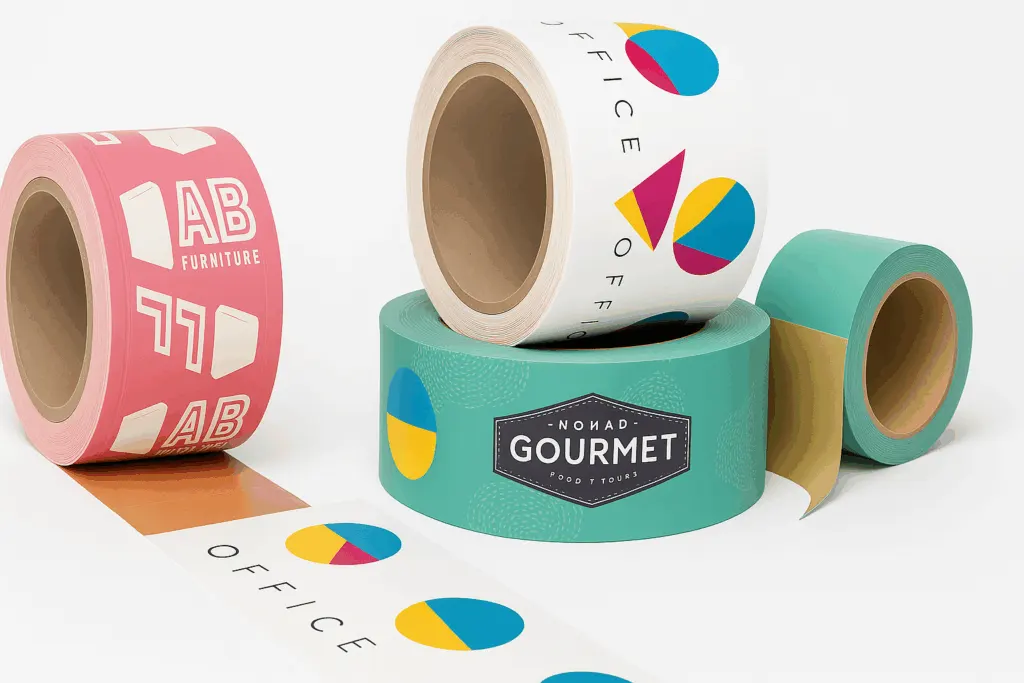
The shift toward custom-printed tape has accelerated for several compelling reasons.
1. The unboxing experience has become critical. With social media unboxing videos continuing to drive brand awareness, the packaging experience matters more than ever. Custom printed tape creates an immediate brand impression before the box is even opened — the same logic that drives brands toward custom mailer boxes and branded poly mailers.
2. Security concerns are increasing. Package theft and tampering remain significant issues. Custom printed tape makes packages harder to tamper with unnoticed, since the tape can’t be cleanly replaced without visible evidence — a meaningful advantage over standard clear tape.
3. Cost-effective branding. Custom boxes remain relatively expensive, especially for small businesses. Custom tape gives you similar brand visibility at a fraction of the cost:
- Custom printed boxes: $1.50–$4.00 per box
- Standard boxes with custom tape: $0.30–$0.60 per box
4. Lower minimum orders. Plus Packaging now offers custom printed tape with minimums as low as 6 rolls, making it accessible even for businesses shipping a few hundred packages monthly. This has let small brands compete with larger companies on presentation. Start with a free digital mockup to see your design first.
5. Sustainability messaging. Custom printed kraft tape lets businesses visibly demonstrate eco-friendly practices. Messages about recyclability or sustainability can be printed directly on the tape, reinforcing brand values — part of a broader eco-friendly packaging strategy.
Sustainability Trends in Packaging Tape for 2026
The packaging industry continues to evolve toward more sustainable options.
Paper-based solutions leading the way. Paper-based tapes have seen rapid adoption growth in recent years. Water-activated kraft tape is biodegradable and recyclable with the cardboard box, eliminating the need to separate materials for recycling. Recent innovations include reinforced paper tapes with plant-based strengthening fibers, water-activated tapes that use less water in application, and paper tapes with improved water resistance for challenging shipping conditions.
Reduced material usage through better design. Stronger tapes mean you can use less — one strip of quality tape instead of wrapping boxes multiple times with weaker tape. Many businesses report meaningfully lower tape usage after switching to higher-quality options, which lowers both cost and waste.
Plant-based bonding gaining ground. While still developing, plant-based adhesives derived from sources like pine resin and vegetable oils are improving in performance. These alternatives reduce dependence on petroleum-based bonding agents and often offer better biodegradability.
Plus Packaging has been part of this shift, offering eco-friendly custom tape options that don’t sacrifice strength or print quality, plus complementary compostable mailers and paper mailers. For a tailored plan, our sustainability consultingteam can help.
How to Apply Tape Properly (Yes, There’s a Right Way)
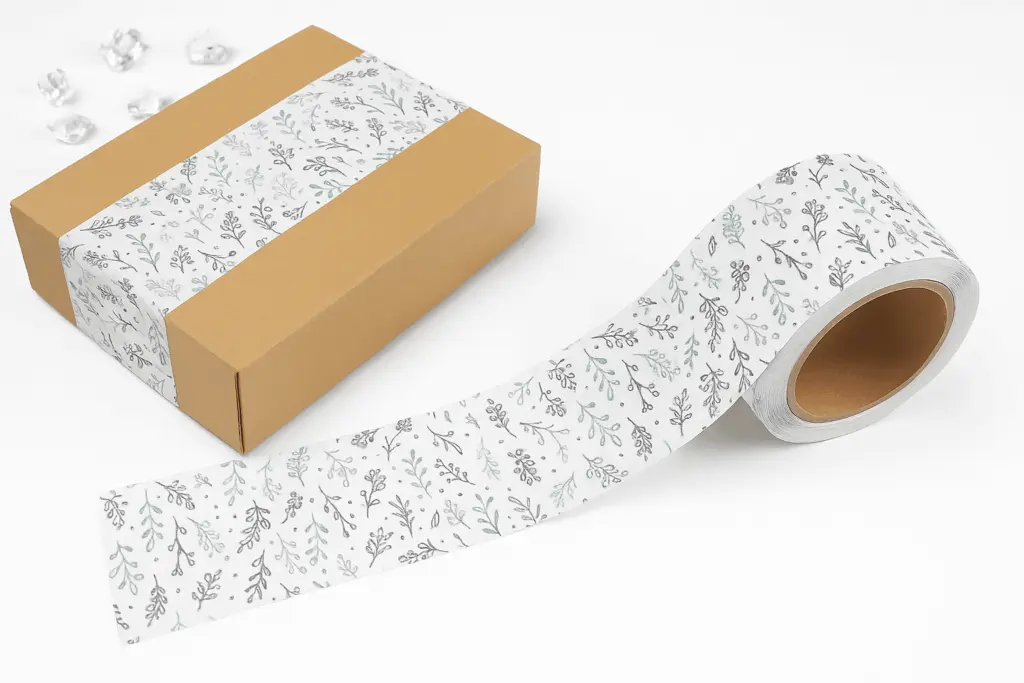
Even the best tape won’t perform well if applied incorrectly. Here are the techniques that make a difference.
For water-activated tape:
- Proper wetting: The tape needs to be uniformly wet but not dripping. Too little water means poor adhesion; too much means messy application.
- Immediate application: Apply within 10 seconds of wetting for optimal adhesion.
- Pressure application: Press firmly along the entire length of the tape to activate the bonding compound.
- H-taping method: For maximum security, create an H-pattern — seal the center seam first, then apply tape perpendicular across each end.
For pressure-sensitive tapes (clear, heavy-duty):
- Clean surface: Remove dust or debris from the box surface before applying.
- Tension application: Pull the tape tight as you apply it to prevent wrinkles and air bubbles.
- Burnishing: Rub the tape firmly after application to fully activate the adhesive.
- Temperature awareness: In cold environments, warm the boxes before taping if possible.
Pro tip: For maximum security with any tape type, extend at least 2 inches of tape down each side of the box beyond the seam.
Which Tape Should You Use? Decision Table
Match your shipping situation to the right tape type using this quick reference.
| Situation | Best Tape Type | Why |
| E-commerce brand shipping to customers | Custom printed kraft tape | Branded unboxing, tamper evidence, eco-friendly, bonds with cardboard |
| Warehouse: high-volume box sealing | Clear carton sealing tape (2.5 mil) | Fast dispenser application, cost-effective at volume |
| Heavy items (30 lb+) | Water-activated gummed tape | Creates a mechanical bond with box fibres — 3x stronger than plastic tape |
| Cold storage / frozen goods | Cold-temperature acrylic tape | Maintains adhesion at temperatures from -20°F to 0°F |
| Pallet bundling / irregular shapes | Filament/strapping tape | Fibre reinforcement resists tearing; handles uneven surfaces |
| Internal returns processing | Clear carton sealing tape (2.0 mil) | No branding needed; lowest cost per roll |
| Eco brand with sustainability messaging | Custom printed kraft tape | Recyclable with the box; print sustainability messages directly on tape |
| Moving/storage boxes, long-term | Long-term storage acrylic tape | UV-resistant adhesive holds through temperature extremes for years |
Frequently Asked Questions
What is the strongest packaging tape?
Reinforced water-activated gummed tape (with fiberglass strands) creates the strongest bond for sealing shipping boxes. It permanently bonds to cardboard fibers, cannot be cleanly removed, and a single 3″ strip replaces 24+ inches of standard plastic tape on heavy packages. For pure tensile strength (strapping and reinforcement), filament tape is the top performer.
What type of tape do professional packers use?
Professional fulfillment centers typically use water-activated tape dispensers for heavy boxes and clear carton sealing tape (2.0–2.5 mil) for standard shipments. Branded e-commerce operations increasingly use custom printed kraft tape across all outbound parcels for the combination of tamper evidence, brand visibility, and eco-credentials.
What packaging tape works best in cold temperatures?
Cold-temperature acrylic tapes are formulated for refrigerated or frozen applications and maintain adhesion from -20°F upward. For shipments sealed at room temperature that only encounter cold in transit, a high-quality acrylic-adhesive carton sealing tape (not hot-melt) usually performs adequately. Test before committing to volume.
Is custom printed tape worth the extra cost?
For businesses shipping directly to customers, yes — at most shipping volumes. The cost difference over standard tape is typically 2–3 cents per foot, but custom tape reduces total tape needed (a stronger bond requires fewer strips), provides tamper evidence that cuts customer-service issues from repackaged returns, and turns every parcel into a branded touchpoint. Businesses shipping fewer than 200 parcels a month may find the cost-to-benefit ratio less compelling. (See our stock vs custom packaging guide for the broader trade-off.)
Can packaging tape be recycled?
Plastic-based tapes (clear carton sealing, filament, hot-melt varieties) must be removed from cardboard before recycling, since leaving plastic tape on cardboard contaminates the paper recycling stream. Paper-based and water-activated kraft tapes can typically be recycled with the cardboard box without separation, making them the more sustainable choice for businesses processing recycling at scale.
How long does packaging tape last in storage?
Standard hot-melt clear tape lasts 1–2 years; water-activated and custom kraft tape, 2–3 years; long-term storage acrylic tape, 3+ years. Store all tape in a cool, dry location away from direct sunlight and temperature extremes. Tape stored above 80°F or below 40°F for extended periods degrades faster — test a sample from any roll stored over 12 months before using on shipments.
What is the difference between shipping tape and packing tape?
These terms are used interchangeably in most retail contexts, but there’s a distinction. Shipping tape (carton sealing tape) is optimized for sealing packages for carrier transit — thinner, lighter, focused on immediate bond strength. Packing or storage tape has a more aggressive adhesive designed to hold through temperature changes over months or years. For most e-commerce shipping, a standard 2.0–2.5 mil carton sealing tape covers both use cases.
How many strips of tape does a box actually need?
For a standard corrugated box, the H-taping method — one strip along the center seam and one across each end — is sufficient for most shipments up to 40 lb when using 2.5 mil or heavier tape. A higher-quality tape applied correctly typically outperforms wrapping a box in multiple strips of lightweight tape. Boxes over 40 lb, or boxes with heavy or sharp contents, should add an extra strip along the center seam.
Choosing the Right Tape for Your Business
The right tape comes down to three questions: what is the box carrying (weight, fragility, value), where is it going (temperature, distance, handling), and what impression do you want to make when it arrives. For most e-commerce businesses shipping direct to consumers, custom printed tape answers all three better than any other option — strongest bond for cardboard, tamper-evident, eco-friendly, and carrying your brand all the way to the customer’s door.
Explore our range of custom printed tape and all packaging products, order samples of our custom poly mailers to see how branded packaging works as a complete system, or browse custom retail bags for complementary in-store and gifting packaging. Ready to brand your shipments? Get a free quote or see why brands trust us.