

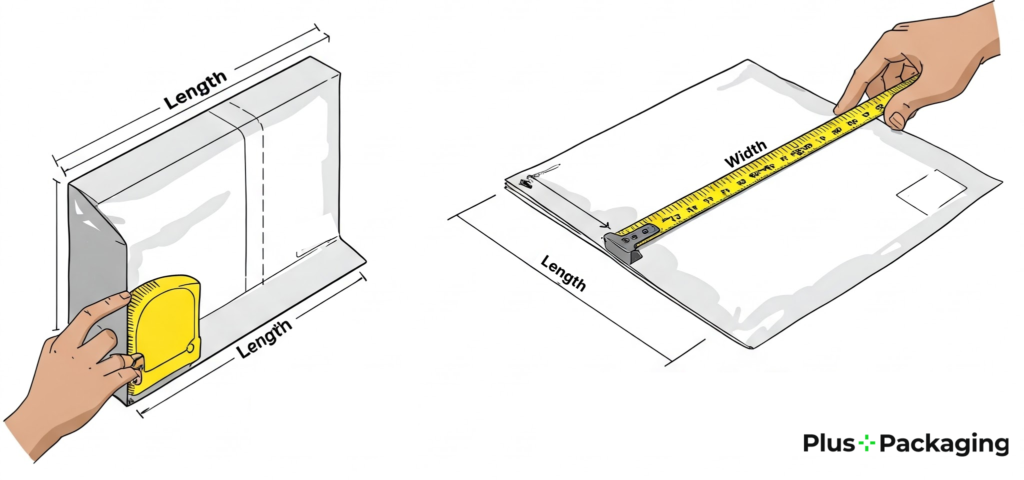
Choosing the right poly mailer size sounds straightforward until you realize that a bag labeled “10 x 13” does not tell the whole story. That measurement is the flat bag dimension, not the usable interior space available for your product. The adhesive flap eats into one end. The side seams take a sliver off each edge. And if your item has any thickness at all, the three-dimensional volume of your packed product has to fit inside a two-dimensional bag.
Get the measurement wrong in either direction and you pay for it. A mailer that is too small stresses the seams, often fails to seal, and can burst in transit. A mailer that is too large lets your product shift, raises your dimensional weight charges, and looks sloppy when it lands at your customer’s door. This guide gives you the exact steps, formulas, and size references you need to measure correctly every time, whether you are buying custom poly mailing bags for the first time or recalibrating your current setup.
Understanding Poly Mailer Dimensions: What the Numbers Actually Mean
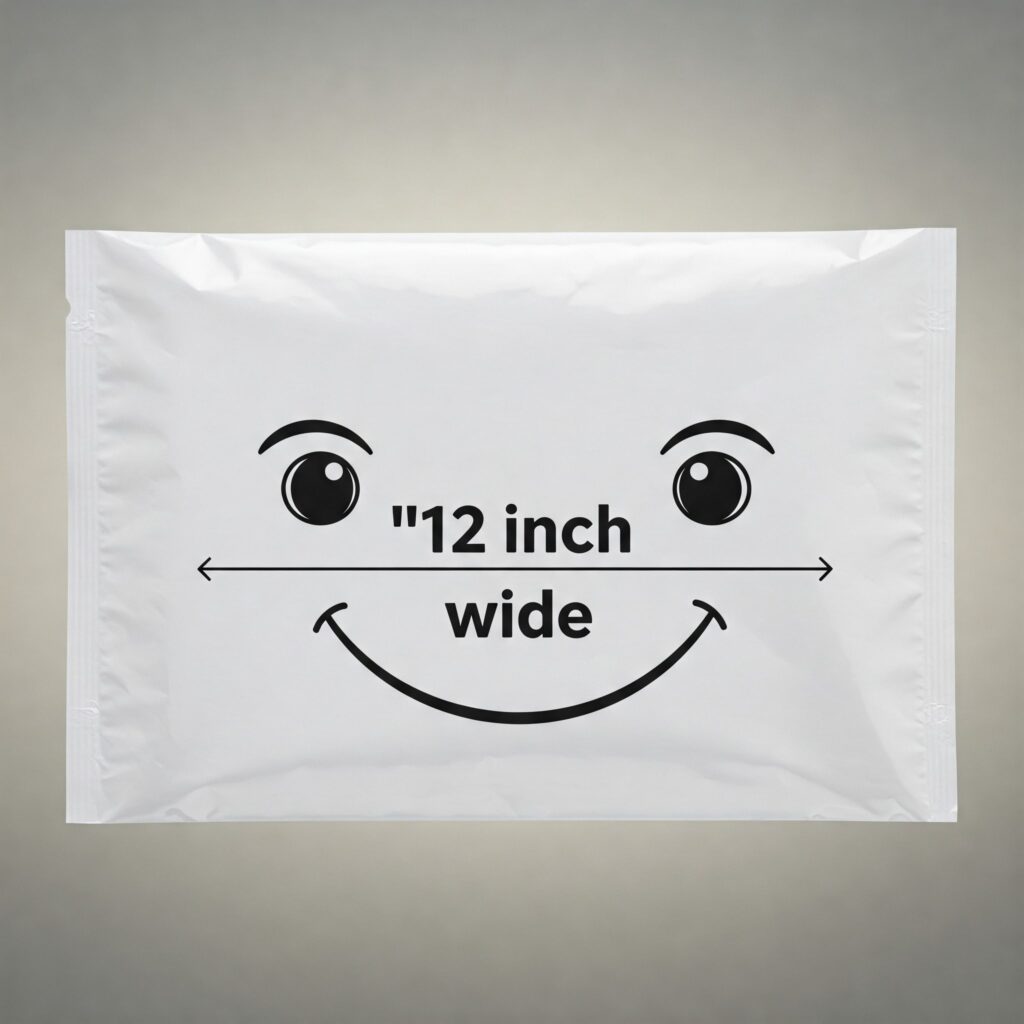
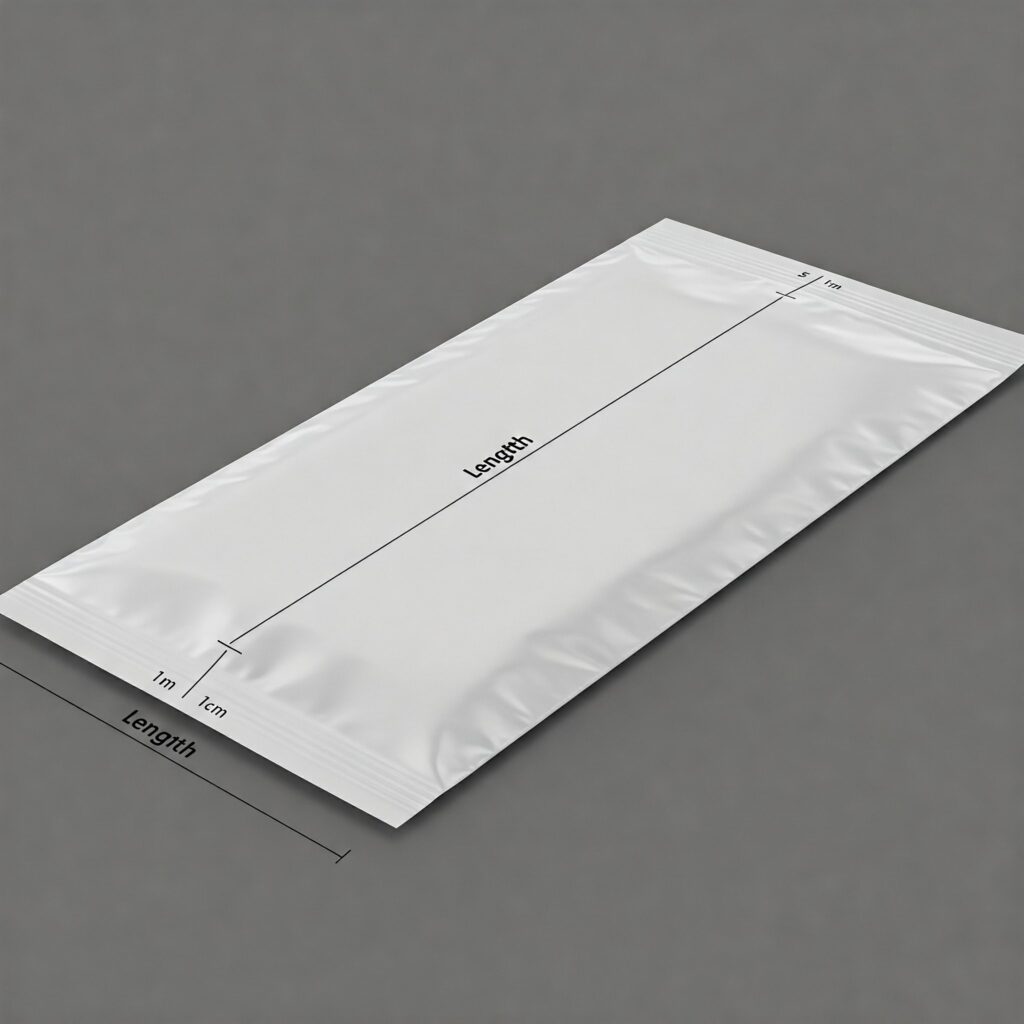
Every poly mailer is described by two numbers: width x length. A 10″ x 13″ mailer is 10 inches wide and 13 inches from the bottom seam to the top of the bag including the adhesive flap. The first number is always width. The second is always total length.
What those numbers do not tell you directly:
- Usable width: The stated width is the flat outer measurement. Side seams reduce the usable interior width by a small amount, typically around a quarter inch per side. For practical purposes, treat the stated width as your usable width.
- Usable length: The stated length includes the adhesive flap, which is typically 1.5 to 2 inches long. That flap folds down over the opening to seal the bag and does not contribute to usable interior space. A 10″ x 13″ mailer has roughly 11 to 11.5 inches of usable internal length, not 13 inches.
- Thickness: Poly mailers are flat bags. They do not have a stated depth dimension. When you pack a three-dimensional item inside, the bag stretches to accommodate the thickness, which increases the overall dimensions of the filled package. This matters for both carrier size classification and dimensional weight calculations.
Step 1: Measure Your Product in Its Packed State
Measure your item the way it will actually sit inside the bag, not how it looks on the shelf. A folded t-shirt has different dimensions than a hanging t-shirt. A stacked set of accessories in a clear inner bag has different dimensions than each item measured individually.
Take three measurements using a ruler or measuring tape:
- Length (L): The longest dimension of the packed item when it is lying flat.
- Width (W): The shorter horizontal dimension, perpendicular to the length.
- Thickness (T): How tall the item is when lying flat. For a single folded t-shirt this might be 0.25 to 0.5 inches. For a folded hoodie it could be 1.5 to 2 inches. For a stacked multi-item order it could be 3 inches or more.
Write all three measurements down before you do anything else. Eyeballing dimensions is the single most common cause of ordering the wrong bag size.
Step 2: Apply the Sizing Formula
The formula converts your product’s three dimensions into the minimum poly mailer size you need. It accounts for the thickness of the item pushing out on all sides when packed:
Minimum mailer width = Product width (W) + Product thickness (T) + 1 inch
Minimum mailer length = Product length (L) + Product thickness (T) + 2 inches
The extra inch on the width provides room for the item to sit without pressing hard against both seams. The extra two inches on the length accounts for the adhesive flap (1.5 to 2 inches) and a small margin for easy loading and sealing.
Worked example: folded t-shirt
A folded adult t-shirt measures 9″ wide x 12″ long x 0.5″ thick when packed flat.
- Minimum mailer width: 9 + 0.5 + 1 = 10.5 inches
- Minimum mailer length: 12 + 0.5 + 2 = 14.5 inches
The nearest standard size at or above both minimums is the 10″ x 13″. Wait, the formula says 10.5″ wide. Does a 10″ x 13″ work? In practice, yes for a single standard t-shirt because poly film has some stretch and a 10″ bag can accommodate a 10.5″ packed width with a single folded garment. But for heavier items, thicker garments, or multi-item packs, always size up to a 12″ x 15.5″ rather than relying on stretch. The formula gives you the minimum. When in doubt, go up one size.
Worked example: folded hoodie
A folded adult hoodie measures 11″ wide x 13″ long x 2″ thick.
- Minimum mailer width: 11 + 2 + 1 = 14 inches
- Minimum mailer length: 13 + 2 + 2 = 17 inches
The nearest standard size is 14.5″ x 19″. A 12″ x 15.5″ would be too small in both dimensions for this item. This is why measuring the actual packed thickness matters so much for bulkier garments.
Worked example: flat document or thin paperback
A standard 8.5″ x 11″ document or thin paperback has negligible thickness of about 0.1 inches.
- Minimum mailer width: 8.5 + 0.1 + 1 = 9.6 inches
- Minimum mailer length: 11 + 0.1 + 2 = 13.1 inches
A 10″ x 13″ covers both dimensions. For a slightly cleaner fit on flat documents, a 9″ x 12″ works if the exact pages measure closer to 8″ x 10″.
Step 3: Match Against the Standard Size Chart
Once you have your minimum required dimensions from the formula, match them against the standard poly mailer size range. Always choose the size that meets or exceeds both your minimum width and minimum length. Never choose a bag that is smaller than your calculated minimum in either dimension.
| Mailer Size | Usable Interior Length* | Best For |
| 6″ x 9″ | ~7″ | Socks, underwear, small accessories, jewelry, phone cases, samples |
| 7.5″ x 10.5″ | ~8.5″ | Thin single garments, small documents, scarves, light accessories |
| 9″ x 12″ | ~10″ | Children’s clothing, small paperbacks, A4 documents, single blouses |
| 10″ x 13″ | ~11″ | Adult t-shirts, shorts, light pants, single garments, small accessories orders |
| 12″ x 15.5″ | ~13.5″ | Sweaters, dresses, jeans, multi-item soft goods orders, light home textiles |
| 14.5″ x 19″ | ~17″ | Hoodies, coats, bulky multi-item orders, larger home goods, thick garments |
*Usable interior length = stated length minus approximately 2 inches for the adhesive flap.
Most e-commerce businesses shipping apparel find that keeping a 10″ x 13″ and a 12″ x 15.5″ in stock covers the majority of single and multi-item orders. A 14.5″ x 19″ handles heavier outerwear and oversized items. If your catalog extends to very small items like jewelry or accessories, add a 6″ x 9″ to your rotation.
How to Measure an Existing Poly Mailer
If you already have poly mailers on hand and need to confirm their usable dimensions before packing, follow these steps:
Measuring width
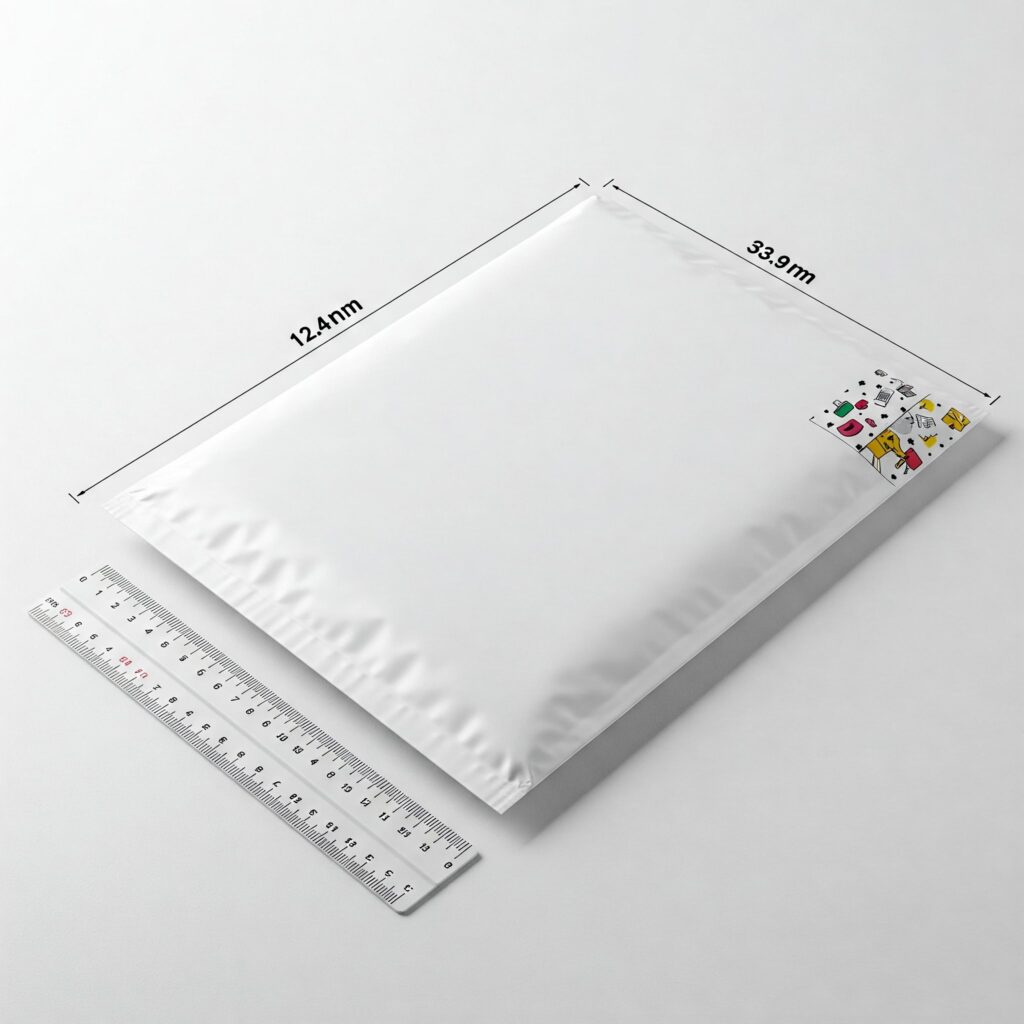
Lay the mailer flat on a table without stretching the material. Smooth it out so it lies completely flat. Measure straight across the opening from the left edge to the right edge, excluding the side seams. This is the interior usable width.
Measuring length
Measure from the bottom seam up to the crease line where the adhesive flap begins, not to the very top of the flap. The flap folds over the opening to seal and does not add usable interior space. Stop your measurement at the fold point. That number is your usable interior length.
Confirming thickness capacity
Poly mailers do not have a stated depth. To check whether a bag will accommodate a specific item’s thickness, place the item flat inside the open bag. If the bag can still close and the adhesive strip can reach across the opening and seal without strain, the thickness is within capacity. If the bag billows and the adhesive strip barely reaches, size up.
Mil Thickness: The Measurement Most People Miss
Beyond width and length, poly mailers have a third critical measurement: wall thickness, measured in mils. One mil equals 0.001 inches. Thicker bags resist punctures better, hold up under heavier loads, and are less likely to split at the seams if a product shifts aggressively during transit.
Here is a practical guide to choosing the right mil thickness:
- 2 mil: Lightweight documents, flat items under 0.5 lb. This is the minimum thickness accepted by USPS for easy loads up to 5 lb.
- 2.5 mil: The industry standard for most clothing and soft goods. Handles standard apparel shipments reliably across all major carriers.
- 3.0 to 3.5 mil: Recommended for heavier garments, items with sharp corners or zippers, and products where the seams will be under more stress during packing.
- 4 to 6 mil: Packages over 2 lb, items with irregular shapes, or anything that puts significant lateral pressure on the bag wall. USPS requires a minimum of 4 mil for loads between 5 and 10 lb.
USPS will not accept poly mailers for loads exceeding 10 lb. For those shipments, use a corrugated box. Custom poly mailing bags from Plus Packaging are available in standard 2.5 mil construction, which meets USPS, UPS, and FedEx requirements for the vast majority of soft goods shipments.
How Mailer Size Affects Dimensional Weight and Shipping Cost
Size selection is not just a product protection question. It is a cost question. All three major carriers, USPS, UPS, and FedEx, apply dimensional weight pricing to packages above certain size thresholds. Dimensional weight is calculated by multiplying the package’s length x width x height and dividing by a carrier divisor (typically 139 for UPS and FedEx; USPS applies it to Priority Mail packages with any dimension over 12 inches). The carrier charges whichever is greater: actual weight or dimensional weight.
A well-fitted poly mailing bag with minimal excess space keeps the packed dimensions tight to the product, which typically keeps dimensional weight below actual weight for soft goods shipments. An oversized bag creates air volume that inflates dimensional weight and can push a low-weight shipment into a higher pricing bracket.
For a concrete example: a folded t-shirt weighing 6 oz. in a right-sized 10″ x 13″ mailer has packed dimensions of roughly 10″ x 13″ x 0.5″, giving a volume of 65 cubic inches. At a divisor of 139, the dimensional weight is well under 1 lb, so actual weight drives the postage. The same shirt in a 14.5″ x 19″ mailer with excess space could measure 14.5″ x 19″ x 1″ at a volume of 275 cubic inches, and at some carriers that pushes into dimensional weight territory. Choosing the right size for the right product is a genuine cost-per-shipment optimization.
Measuring for Specific Product Types
Apparel and clothing
Always measure garments in the exact folded configuration your packing team will use. Define a standard fold for each SKU type and train your team to use it consistently. Inconsistent folding creates inconsistent packed dimensions, which leads to using the wrong bag size or having to repack. For most adult garments:
- Single t-shirts: 10″ x 13″
- Jeans, sweatpants, dresses: 12″ x 15.5″
- Hoodies and light jackets: 12″ x 15.5″ or 14.5″ x 19″ depending on thickness
- Heavy coats and oversized garments: 14.5″ x 19″
- Multi-item orders: measure the stacked items together and apply the formula
Books and documents
Books and documents have very low thickness, so the formula adds minimal extra to width and length. The main concern is that the mailer is large enough that the label placement zone covers the full address and barcode without folding over an edge. A 9″ x 12″ covers standard paperbacks and A4 documents. A 10″ x 13″ gives more label clearance for larger formats. For items that need cushioning, custom paper padded mailers are available in the same size range and add paper-based cushioning inside.
Small accessories, jewelry, and phone cases
Small items in a large bag shift extensively during transit. Shift damage on fragile accessories is a common cause of returns. Measure the actual packed dimensions including any inner packaging such as a card backing or a small poly bag, then apply the formula. A 6″ x 9″ covers most small accessory shipments. If the items are fragile, use a custom bubble mailer in the appropriate size for cushioning.
Multi-item and subscription orders
Stack all items in the exact configuration they will be packed and measure the stacked dimensions, including any tissue paper, inner bags, or inserts. That stacked measurement is your effective product size for the formula. For orders where the contents vary by customer, build a measurement table for common combinations and train your packing team on which bag size each combination requires.
Fragile items
Standard poly mailers do not provide cushioning. For any item that can crack, chip, or break under impact, measure for a bubble mailer or paper padded mailer instead. Both formats are measured using the same width x length system, and bubble mailers run slightly wider for a given stated size because of the added interior padding layer. When measuring for a bubble mailer, use the same formula as for a standard poly mailer but verify that the interior usable space (not just the stated exterior size) accommodates your product.
Measuring for Custom-Printed Poly Mailers
When ordering custom poly mailing bags with your branding, size measurement has a design implication as well as a product fit implication. Your printed design must account for:
- The adhesive flap zone: The top 1.5 to 2 inches of the bag folds over and seals. Any design element printed in this zone will be folded under and hidden after sealing. Keep branding elements at least 2 inches from the top edge.
- The label placement zone: Your design should include a clear, unprinted or lightly printed area at least 4″ x 6″ for the shipping label and barcode. If the label overlaps a dark or busy design area, the barcode may not scan reliably at carrier sorting facilities. Specify your label zone when you submit artwork.
- The side seam margins: Leave at least 0.25 inches of clearance inside the side seam lines. Design elements too close to the seam edge can wrap or distort after sealing.
Plus Packaging provides free digital mockups before production so you can confirm that your design fits correctly within the chosen bag dimensions and that the label zone and branding do not interfere with each other. Request samples to verify the physical fit with your actual products before placing a full order.
Sustainable Mailer Options in the Same Size Range
Once you have your correct measurements, the format choice is yours. All of Plus Packaging’s mailer formats are available in the same standard size range, so moving from one material to another does not require remeasuring your products.
- Custom poly mailing bags for most apparel and soft goods, available in recyclable materials.
- Custom compostable mailers as a direct plastic-free swap for brands with sustainability commitments. Same dimensions, same performance, plant-based material.
- Custom paper mailers for flat, lightweight items where a recyclable kraft paper feel is preferred.
- Custom paper padded mailers for items needing light cushioning in a fully recyclable construction.
- Custom bubble mailers for fragile items that need impact protection without a full corrugated box.
Common Poly Mailer Measuring Mistakes
These are the errors that lead to the wrong size order most often:
- Measuring the product unfolded or unpackaged: Always measure in the packed state your product will actually be in when it goes into the bag.
- Ignoring thickness: A flat item and a bulky item with the same length and width need different sized bags. Thickness is not optional in the formula.
- Confusing total bag length with usable interior length: The stated length includes the adhesive flap. Subtract 2 inches to get usable interior length before comparing to your product dimensions.
- Not accounting for inner packaging: Tissue paper, clear inner bags, and inserts all add to the effective packed dimensions. Measure with them included.
- Ordering one size for products that vary significantly: A single t-shirt and a stacked three-item order do not fit the same bag. Stock two or three sizes and match the bag to the order contents at packing.
- Forgetting the label zone when designing custom bags: A beautiful design that covers the entire bag leaves nowhere to put a scannable label. Build the label zone into your design before you go to print.
Frequently Asked Questions
How do I know what size poly mailer I need?
Measure your product’s length, width, and thickness in its packed state. Apply the formula: mailer width = product width + product thickness + 1 inch; mailer length = product length + product thickness + 2 inches. Match the results against the standard size chart and choose the nearest size that meets or exceeds both numbers.
Does the stated poly mailer size include the adhesive flap?
Yes. The stated length (the second number in a size like 10″ x 13″) includes the adhesive flap, which is typically 1.5 to 2 inches long. Usable interior length is the stated length minus approximately 2 inches. Always calculate product fit against usable interior length, not the stated total length.
What happens if I use a poly mailer that is too small?
An undersized bag stresses the seams when you force the item in. The adhesive strip may not reach across the overfull opening to seal properly. If the bag does seal, the stressed seams are more likely to split during transit. The result is a package that opens en route, a damaged or lost item, and a support request from your customer.
What happens if I use a poly mailer that is too large?
An oversized bag lets the item shift and fold on itself during transit, which can cause creasing, scuffing, or damage even for non-fragile goods. The excess air and material volume also inflates dimensional weight, which raises your carrier charges. A large empty bag also looks unprofessional when it arrives deflated and loose around a small product.
How do I measure a poly mailer for dimensional weight purposes?
Measure the filled, sealed package at its longest length, widest width, and maximum height (thickness when lying flat). Multiply those three numbers together. Divide by your carrier’s dimensional weight divisor (139 for UPS and FedEx commercial; USPS applies dimensional weight to Priority Mail packages with any dimension over 12 inches). The result is your dimensional weight in pounds. If it is greater than your actual weight, you will be charged based on dimensional weight.
What mil thickness should I choose for standard clothing shipments?
2.5 mil is the industry standard for most clothing and soft goods. For heavier garments or items with zippers, buttons, or sharp edges, 3.0 to 3.5 mil is a better choice to protect the bag wall from punctures.
Can I use the same size measurements for compostable or paper mailers?
Yes. Compostable mailers and paper mailers from Plus Packaging use the same standard dimensions as poly mailers. The same formula and size chart applies. Switching formats does not require remeasuring your products.
Poly Mailer Measuring: Quick Reference Summary
Three steps cover every measuring scenario:
- Step 1. Measure your product in its packed state: length (L), width (W), and thickness (T).
- Step 2. Apply the formula. Minimum mailer width = W + T + 1″. Minimum mailer length = L + T + 2″.
- Step 3. Match against the size chart. Choose the standard size that meets or exceeds both minimums. When between two sizes, size up.
When you are ready to order, Plus Packaging offers custom poly mailing bags, bubble mailers, paper mailers, paper padded mailers, and compostable mailers in all standard sizes with custom printing, free digital mockups, and physical samples available before you commit to a full order. Minimums start at 150 pieces.