

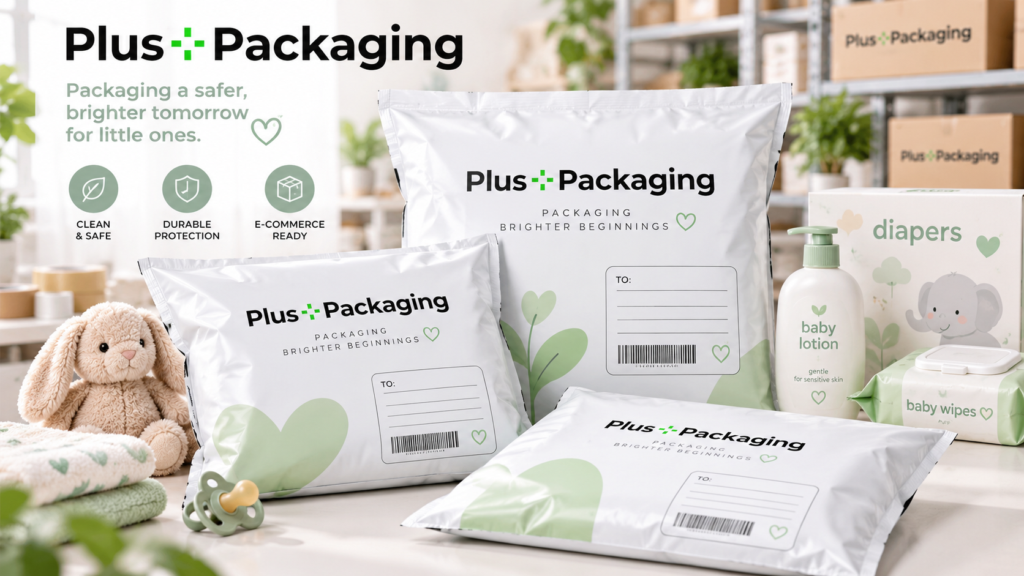
Baby product packaging does more work than almost any other category. It has to protect delicate items, meet children’s product safety rules, look trustworthy to anxious new parents, and often double as a gift. A torn bag, a crushed box, or a mailer that arrives damp can make a parent doubt whether what’s inside is clean and safe before they’ve even opened it.
This guide covers the main types of baby product packaging, the safety and labeling requirements that commonly apply, design and sustainability trends, and how to pick the right shipping packaging for online orders.
Why Baby Product Packaging Matters
Parents buy baby products with more caution than most shoppers, so packaging carries extra weight in four ways:
- Safety. Materials and inks that sit near a baby need to be non-toxic, and warnings need to be clear.
- Hygiene. Items that touch a baby should arrive clean, dry, and sealed.
- Trust. Neat, intact packaging signals that the seller pays attention to detail.
- Gifting. Baby products are often bought as gifts, so presentation counts for more than it would for a utility item.
Common Types of Baby Product Packaging
| Packaging type | Best for | Notes |
|---|---|---|
| Folding cartons | Feeding accessories, skincare, small toys | Lightweight, printable, easy to stack on shelves |
| Window boxes | Soft toys, rattles, clothing sets | Lets buyers see the product |
| Rigid gift boxes | Premium sets, newborn gift bundles | Strong unboxing experience |
| Sleeves and wraps | Bibs, burp cloths, muslins | Low cost, minimal material |
| Blister and clamshell packs | Pacifiers, teethers, small accessories | Protects small items, good for retail hooks |
| Tubes and bottles | Creams, wipes, baby care liquids | Often need tamper-evident closures |
| Subscription and gift boxes | Curated baby boxes | Brand-forward, designed for unboxing |
| Shipping mailers | Online orders of clothing, accessories, and kits | Protects the product in transit |
Retail packaging gets the most attention in design, but the shipping layer is what the customer meets first when they buy online.
Safety and Labeling Requirements
Rules vary by product type, country, and sales channel, so treat this as orientation rather than a full legal checklist. In the United States, these requirements come up most often:
- Third-party testing and certification. Products designed for children 12 and under generally need testing by a CPSC-accepted lab and a Children’s Product Certificate (CPC), issued by the manufacturer or importer.
- Tracking labels. Children’s products generally need permanent marks showing the manufacturer or importer, production location and date, and batch or lot information, so recalls can be targeted. The CPSC publishes guidance on where these appear, including on packaging.
- Choking hazard warnings. Toys and games for children aged 3 to 6 with small parts need a choking hazard warning. Products for children under 3 cannot contain small parts.
- Age grading. Age labels are a compliance matter, not only a marketing choice.
- Chemical limits. Limits apply to lead and certain phthalates in children’s products.
- Plastic bag warnings. Many platforms and retailers require a suffocation warning on poly bags above a set opening size. Check the rules of each channel you sell through.
- Warning visibility. Don’t cover required warnings or tracking labels with shipping labels or tape.
This is general information, not legal advice. Confirm requirements for your specific products with the CPSC or a compliance professional.
Materials and Safe Design Choices
- Non-toxic inks and coatings. Choose soy or water-based inks and avoid placing printed surfaces directly against items a baby will mouth.
- BPA-free plastics where plastic is used for containers or windows.
- Paper and paperboard for cartons, sleeves, and inserts, which are widely recyclable.
- Minimal layers. Fewer mixed materials make recycling easier and lower packaging costs.
Design Trends for Baby Packaging
Baby brands tend to lean on soft palettes, clean layouts, and warm illustration, but the trend is shifting from nursery pastels toward natural tones, earthy kraft, and minimal branding. A few ideas that work:
- Simple, uncluttered layouts that read as safe and calm
- Clear age range and safety information on the front or side panel
- A small insert card with care instructions or a thank-you note
- Tissue wrap or a branded sticker to make an online order feel like a gift
- Consistent colors across cartons, mailers, and inserts
Sustainability in Baby Packaging
Many parents choose brands partly on environmental values, so packaging is part of the pitch. Recyclable cartons, kraft paper, paper-based cushioning, and compostable options all help, as long as the product stays protected. Be careful with claims: regulators are tightening what brands can say about recyclable and compostable packaging, so keep your wording accurate and backed by supplier documentation.
Shipping Baby Products Online
For e-commerce sellers, the shipping mailer is the first thing a customer sees. The right choice depends on what’s inside.
Baby clothing, swaddles, and soft goods
Soft items don’t need cushioning, but they do need protection from moisture and dirt. Custom Poly Mailers are the usual choice. They’re waterproof, tear-resistant, and light, which keeps shipping costs down and fabric clean through rain and rough handling. A printed poly mailer also doubles as branding. If your bags are large enough to need a suffocation warning, make sure it’s printed on them.
Bottles, pacifiers, teethers, and small accessories
Hard items that can chip, crack, or dent need real shock absorption. Bubble Mailers work well for pacifier sets, teething toys, and boxed accessories. Use an inner pouch or wrap so the product stays separate from the bubble lining, especially for anything a baby will put in their mouth.
Eco-minded baby brands
Paper Padded Mailers offer cushioning without a plastic bubble lining, which suits wooden teethers, handmade toys, and boxed sets. For lighter items, Compostable Mailers suit brands built around natural materials and low waste. If you use the word “compostable,” confirm certification with your supplier first.
Books, cards, and flat gifts
Board books, milestone cards, birth announcements, and nursery art are flat and light. Paper Mailers with a stiffener inside protect corners from bending at a lower cost than padded options.
Quick reference
- Clothing, blankets, soft goods: Custom poly mailers
- Hard or breakable items: Bubble mailers
- Natural toys and eco brands needing cushioning: Paper padded mailers
- Light items for sustainability-focused brands: Compostable mailers
- Books, cards, and flat gifts: Paper mailers
Packing Tips for Baby Products
- Bag items individually. An inner sealed bag keeps clothing and soft toys clean inside the mailer.
- Keep ink off contact surfaces. Avoid placing printed material directly against items that go near a baby’s mouth.
- Add a care or safety card. A short insert with washing instructions and age range builds trust and cuts down on questions.
- Pack for gifting. Tissue wrap or a simple branded sticker adds a gift feel at little cost.
- Mind moisture. Choose waterproof or well-sealed options for items that can’t be easily washed.
- Right-size the package. An oversized mailer lets items shift and raises shipping costs.
- Don’t hide required labels. Keep tracking labels and warnings visible and legible.
Frequently Asked Questions
What packaging is safest for baby products? Packaging made from non-toxic, food-safe or child-safe materials, with non-toxic inks, secure closures, and clear warnings where required. The right format depends on the product.
Do baby products need special labels? Many do. Children’s products commonly need tracking labels, age grading, and warnings such as choking hazard notices, depending on the product and age group.
What is the best mailer for baby clothes? A poly mailer is usually the best fit, since it’s waterproof, light, and low cost. Use a paper mailer or compostable mailer if your brand prioritizes lower-plastic options.
How do I ship fragile baby items like bottles? Use a bubble mailer or box with enough cushioning, and wrap the item so it can’t move inside.
Can I use eco-friendly packaging for baby products? Yes. Paper-based options like paper padded mailers and certified compostable mailers work for many products, as long as they protect the item and your claims are accurate.
Final Thoughts
Good baby product packaging protects the item, meets the safety and labeling rules that apply, and gives parents confidence before they open it. At the shipping stage, matching the format to the product keeps it simple: a custom poly mailer for soft goods, a bubble mailer for hard accessories, a paper padded mailer or compostable mailer for eco-focused brands, and a paper mailer for flat gifts.
This article is general information, not legal advice. Check current CPSC requirements for your products before you sell.