

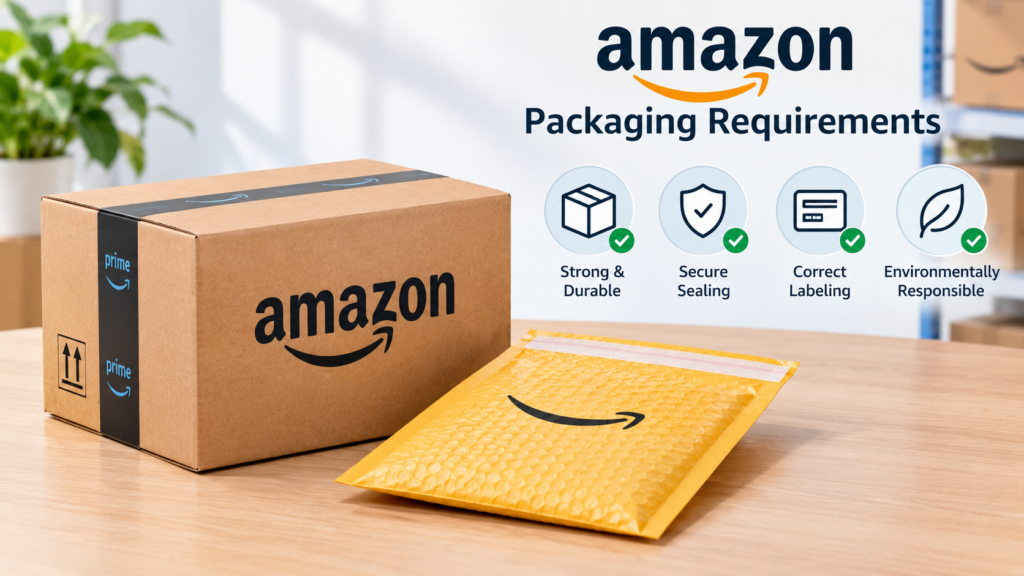
hipping on Amazon isn’t like shipping from your own storefront. Whether you’re sending products to Fulfillment by Amazon (FBA) warehouses or shipping orders yourself through Fulfillment by Merchant (FBM), Amazon has specific packaging rules, and getting them wrong can mean rejected shipments, chargebacks, or products that arrive damaged and trigger returns. None of it is especially complicated once you know what Amazon is actually checking for, but the rules are scattered across different policy pages, which makes them easy to miss.
This guide pulls the key requirements together in one place and explains how to choose packaging that satisfies Amazon’s standards without overspending on materials you don’t need.
Why Amazon Is So Strict About Packaging
Amazon’s packaging rules exist for a few practical reasons. Products move through multiple hands between a seller’s warehouse and a customer’s door, often getting sorted, stacked, and scanned several times along the way. Packaging that fails partway through that process creates damaged inventory, customer complaints, and returns, all of which hurt a seller’s account health metrics.
For FBA specifically, Amazon also has to store and route huge volumes of inventory through its own fulfillment centers, so it needs packaging that scans correctly, stacks safely, and doesn’t damage neighboring products on a shelf or in a tote. That’s the backdrop for most of the specific rules below.
General Packaging Requirements for All Sellers
Regardless of whether you’re using FBA or shipping orders yourself, a few baseline rules apply across the board:
- Products must be protected from damage in transit. This includes cushioning for fragile items and secure sealing so packages don’t open accidentally.
- Packaging must not misrepresent the product. Amazon prohibits packaging that implies a different product, quantity, or condition than what’s actually inside.
- Poly bags must meet safety standards. Any poly bagging used for products, especially items that could pose a suffocation risk, must meet specific thickness requirements and, in many cases, carry a suffocation warning label.
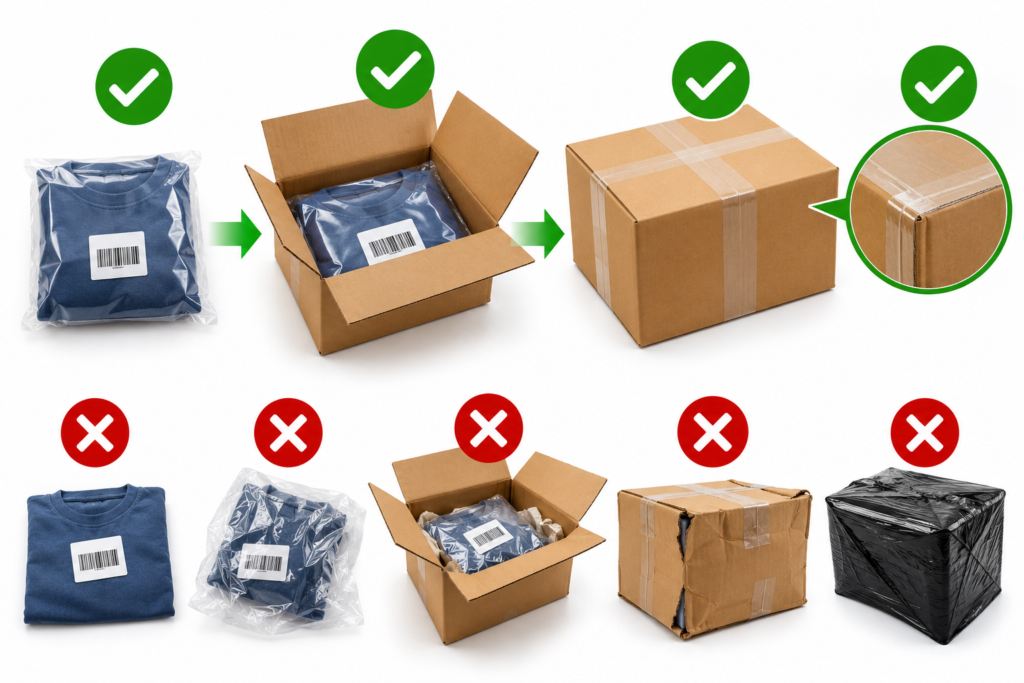
- Barcodes and labels must be scannable. Labels can’t be wrinkled, torn, or obscured by tape, and they need to be placed where scanning equipment can read them without someone having to dig through the package.
These rules apply whether you’re using a box, a padded mailer, or a poly bag, so the packaging material you choose needs to support all four points, not just look presentable.
FBA-Specific Packaging Requirements
If you’re sending inventory into Amazon’s fulfillment network, there’s a more detailed set of rules to follow, since your shipment is going into Amazon’s own handling and storage systems rather than directly to a customer.
Poly Bagging Rules
Amazon requires poly bags for many product types, particularly items that could be damaged by moisture, dust, or contact with other products in a bin. When poly bags are required, Amazon generally expects:
- A minimum thickness, often 1.5 mil or greater depending on the bag’s dimensions
- A suffocation warning label on any bag with an opening larger than 5 inches
- A secure seal so the bag doesn’t open during handling
For sellers shipping soft goods, small parts, or multi-unit sets into FBA, Custom Poly Mailers that meet these thickness and labeling requirements are a practical way to stay compliant without sourcing bags and warning labels separately. Since poly mailers can be ordered with the suffocation warning pre-printed, it removes a step that’s easy to forget when packing inventory at volume.
Box and Carton Requirements
Shipments going into FBA also need to meet Amazon’s standards for the outer shipping carton, separate from the individual product packaging. This includes weight limits per box, proper sealing with pressure-sensitive tape (not string, cord, or staples), and correct labeling on the outside of the carton itself. Mixing this up, like using a padded mailer as the outer shipping container for a bulk FBA shipment instead of a proper carton, is a common reason shipments get flagged at the warehouse.
Fragile and Liquid Items
Products that are fragile or contain liquid need extra cushioning and, in many cases, a plastic bag or liner to contain leaks. Bubble wrap, air pillows, or a cushioned mailer around the individual unit are typically expected before the product goes into the outer shipping carton.
Packaging Requirements for FBM Sellers
If you’re fulfilling orders yourself rather than through FBA, Amazon’s packaging rules are less rigid about the specifics of your materials, but the same underlying expectations apply: products need to arrive intact, labels need to be legible, and packaging shouldn’t misrepresent what’s inside. FBM sellers have more flexibility to choose packaging that fits their brand and budget, as long as it holds up to the realities of carrier handling.
This is where matching the mailer to the product matters most, since FBM sellers are the ones making that call directly rather than following a fulfillment center’s standardized process.
Choosing the Right Packaging Material for Amazon Orders
Different product types call for different packaging, and picking the right one keeps you compliant while controlling cost:
- Soft goods, apparel, and multi-unit sets: Custom Poly Mailers are a common choice for Amazon sellers because they’re lightweight, waterproof, and easy to print with required warning labels when needed. They also keep dimensional weight down, which matters for FBM shipping costs.
- Books, flat prints, and documents: Paper Mailers work well for flat or semi-rigid items that don’t need cushioning but still need protection from bending or moisture.
- Fragile or breakable items: Bubble Mailers provide the shock absorption Amazon expects for items at risk of cracking or denting during transit, particularly for FBM orders shipped directly to customers.
- Sustainability-focused brands: Sellers trying to reduce plastic use can look at Paper Padded Mailers for cushioned protection without bubble lining, or Compostable Mailers for lighter items where an eco-friendly shipping story matters to the brand.
Whichever material you choose, it needs to hold up through Amazon’s handling process, not just look good at the point of packing.
Common Packaging Mistakes That Get Shipments Flagged
A few mistakes come up repeatedly with both new and experienced Amazon sellers:
- Using plain plastic bags without required warning labels. Any bag that could pose a suffocation risk needs the warning printed or labeled, no exceptions.
- Taping over barcodes or labels. Even clear tape can create a glare that prevents scanners from reading the label correctly.
- Under-cushioning fragile items. Relying on a thin mailer alone for glass, ceramics, or electronics usually isn’t enough; internal padding still matters even inside a protective mailer.
- Sending FBA inventory in retail packaging without an outer shipping carton. Amazon generally expects a separate, compliant outer box for inbound shipments, not just the individual product packaging.
- Mismatched box or mailer sizes. Oversized packaging for FBA shipments can affect storage fees, while oversized FBM packaging raises shipping costs unnecessarily.
A Quick Compliance Checklist
Before sending out an Amazon shipment, whether it’s going to a fulfillment center or directly to a customer, it helps to run through a short checklist:
- Confirm whether your product category requires a poly bag and, if so, whether a suffocation warning is needed
- Check that labels and barcodes are flat, unobstructed, and placed where they can be scanned easily
- Make sure fragile items have adequate internal cushioning, not just an outer protective layer
- Verify that outer cartons for FBA shipments meet weight and sealing requirements separately from individual product packaging
- Match your mailer or box size closely to the product to avoid wasted material and unnecessary dimensional weight charges
Final Thoughts
Amazon’s packaging requirements aren’t designed to make life difficult for sellers, they’re built around keeping products intact through a high-volume, multi-step shipping process. Meeting them usually comes down to choosing the right material for the product, whether that’s a custom poly mailer for soft goods, a bubble mailer for anything fragile, a paper mailer for flat items, or a paper padded mailer or compostable mailer for sellers prioritizing sustainability, and making sure labeling and sealing standards are met every time.
Getting this right the first time saves sellers from the slower, more expensive path of rejected shipments, damaged inventory, and customer complaints that come from treating packaging as an afterthought.