

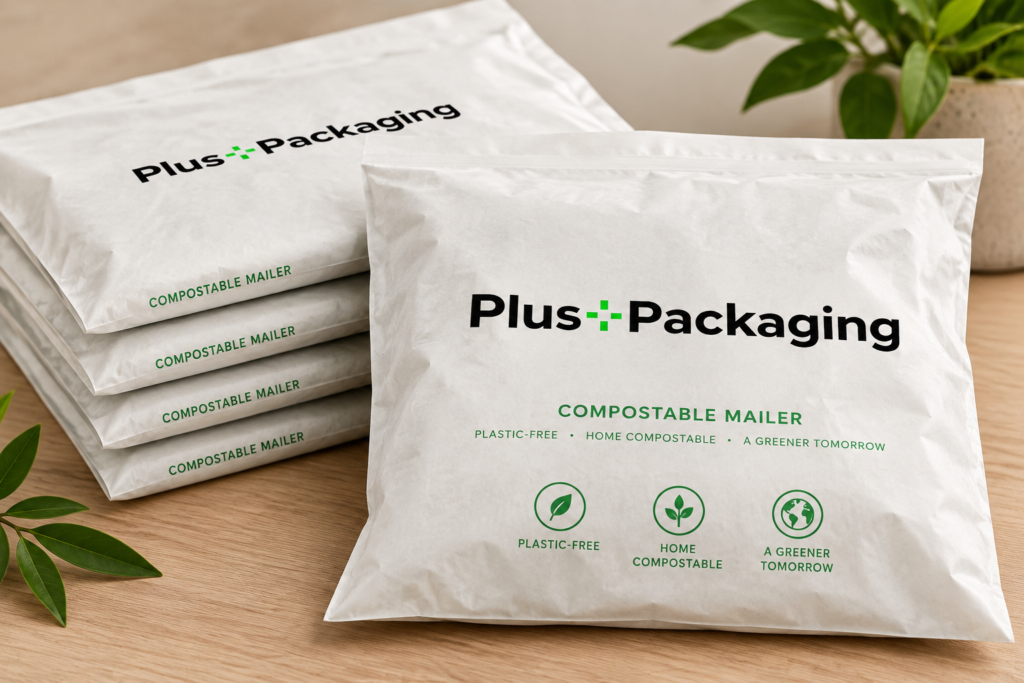
ompostable Mailers look like a simple swap: replace poly with a plant-based film and the packaging problem is solved. In practice, “compostable” covers a range of materials with very different strength, cost, and disposal requirements, and the wrong choice can mean bags that split in transit or that customers throw in the recycling bin, where they don’t belong and won’t break down.
This guide breaks down what actually makes a compostable mailer compostable, which materials hold up for which products, how to size and label them correctly, and when a compostable mailer isn’t the right call. If you’re weighing compostable against other eco-friendly packaging options, this guide covers where it fits alongside Paper Mailers and Paper Padded Mailers too.
What “Compostable” Actually Means
Not every eco-labeled mailer breaks down the same way, and the differences matter for both performance and legal compliance. If your team is navigating these claims for the first time, Sustainability Consulting can help translate certification requirements into an actual packaging spec.
- Industrial vs. home compostable. Most compostable mailers are certified for industrial composting facilities, which run at higher, controlled temperatures. Home compostable mailers break down in a backyard compost pile, but they’re less common and generally weaker.
- Certification matters more than the word “compostable” on a bag. Look for BPI (Biodegradable Products Institute) certification in the U.S. or TÜV Austria’s “OK Compost” mark in Europe. Uncertified bags labeled compostable may not break down within a standard composting cycle, and several U.S. states now restrict uncertified compostable claims on packaging. See the glossary for definitions of related certification terms.
- Compostable is not the same as biodegradable. Biodegradable only means something breaks down eventually, with no defined timeframe or end conditions. Compostable materials are required to break down into non-toxic biomass within a set period under specific conditions.
- Access to composting matters as much as the material. A certified compostable mailer that ends up in a landfill breaks down anaerobically and can release methane, similar to other organic waste in landfill conditions. The environmental benefit depends on the mailer actually reaching a composting facility or system.
Should You Go Compostable, Recyclable, or Reusable?
This decision shapes everything downstream, and it’s worth settling before comparing specific mailer types.
Compostable makes sense for brands whose customers are motivated by end-of-life impact and who are likely to have access to municipal composting, curbside organics collection, or a home compost setup. It’s a strong fit for food-adjacent, beauty, and lifestyle brands with an environmentally engaged customer base, and pairs well with other eco-friendly packaging choices further down the supply chain.
Recyclable options, like Paper Mailers or PCR (post-consumer recycled) Poly Mailing Bags, work better in regions without composting infrastructure, since most consumers have easier access to recycling or standard waste streams than to composting.
Reusable mailers, made from heavier fabric or tear-resistant film with a reseal feature, suit brands doing frequent repeat shipments to the same customers, such as subscription boxes built around Custom Kits.
None of these is universally better. It depends on your customer base’s disposal access and how much weight your product needs to withstand. A Free Digital Mockup can help you compare how each option looks and performs before committing to a bulk order.
Compostable Mailer Materials, Compared
PLA/PBAT Film Blends: The Standard for Flexible Compostable Mailers
Most Compostable Mailers on the market use a blend of PLA (polylactic acid, typically corn-based) and PBAT (a biodegradable polyester), sometimes with added plant starches. This blend mimics the look, feel, and flexibility of a standard Poly Mailer, which makes it the easiest drop-in replacement for brands already used to shipping in poly.
These compostable mailers work well for:
- Apparel, accessories, and other soft goods that don’t need rigid support, similar to what you’d ship in a Poly Mailing Bag today
- Brands wanting a mailer that looks and handles like standard poly, minimizing changes to packing workflows
- Products shipped in dry conditions, since PLA/PBAT film offers decent water resistance short of prolonged soaking
The trade-off is durability under stress. PLA/PBAT film is generally less puncture- and tear-resistant than virgin poly at the same thickness, so brands often need to size up the film gauge to match the strength of a standard Poly Mailing Bag.
Kraft Paper Compostable Mailers: Plastic-Free and Widely Accepted
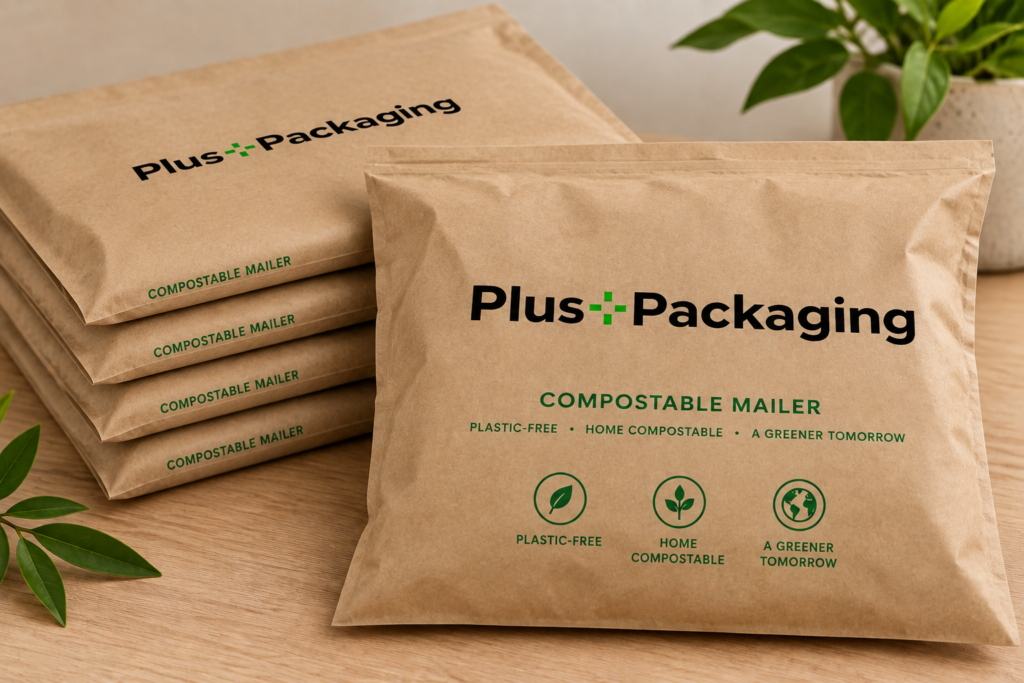
Paper Mailers made from kraft stock are inherently compostable (and recyclable) without added film layers, which sidesteps the industrial-composting-access question entirely, since kraft paper breaks down in most composting systems, including many home setups.
Kraft compostable mailers suit:
- Lightweight, non-fragile items where crush resistance isn’t critical
- Brands prioritizing a natural, tactile unboxing look, often paired with Tissue Paper or Hang Tags for a finished presentation
- Regions where composting infrastructure is inconsistent, since paper degrades in ordinary composting and even standard yard waste conditions
The trade-off is water resistance. Uncoated kraft paper mailers absorb moisture and can weaken or tear in wet conditions, so they’re a better fit for drier shipping routes or need a compostable moisture barrier coating to hold up in transit.
Compostable Padded Mailers: Cushioning Without Plastic Bubble Lining
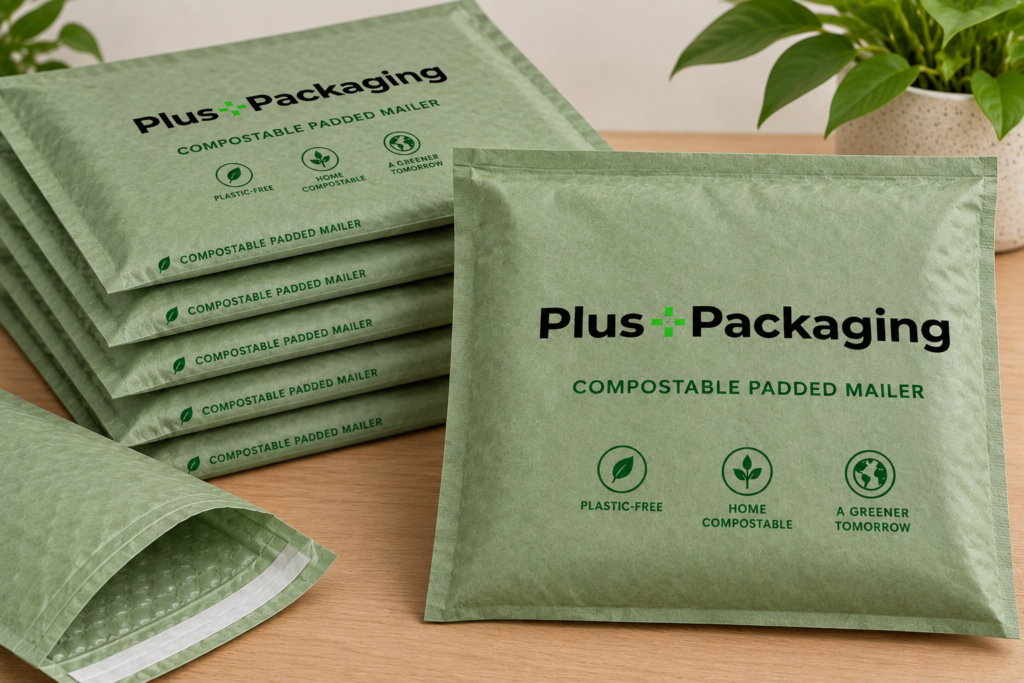
For products that need some impact protection, Paper Padded Mailers made with compostable certification use crumpled or recycled paper fiber as the cushioning layer instead of plastic bubble wrap, paired with either a kraft or PLA/PBAT outer layer.
These work well for:
- Small, moderately fragile items like cosmetics, jewelry, or electronics accessories
- Brands that want cushioning without introducing a non-compostable Bubble Mailer lining into an otherwise compostable package
They add bulk and weight compared to a flat mailer, which can raise shipping costs, and the cushioning is generally less protective than plastic bubble lining against sharp impacts. For heavier or sharper items, a Mailer Box or Molded Pulp Packaging insert may be worth the added structure.
Quick Comparison
| Material Type | Best For | Water Resistance | Durability | Home Compostable |
| PLA/PBAT film (Compostable Mailers) | Soft goods, drop-in poly replacement | Moderate | Moderate | Rarely (usually industrial only) |
| Kraft paper (Paper Mailers) | Lightweight items, plastic-free branding | Low (unless coated) | Low to moderate | Often yes |
| Compostable padded (Paper Padded Mailers) | Small fragile items | Low to moderate | Moderate | Depends on outer layer |
Sizing Guide
Oversizing a compostable mailer wastes material and money; undersizing risks stretching thinner compostable film past its limit at the seams.
| Product Type | Suggested Mailer Size |
| Small accessories, jewelry, single garments | 6″ x 9″ or 9″ x 12″ |
| T-shirts, folded apparel, small multi-item orders | 10″ x 13″ or 12″ x 15.5″ |
| Sweaters, multi-item apparel orders | 14.5″ x 19″ |
| Bulkier soft goods or small boxed items | 19″ x 24″ gusseted mailer |
A few practical notes:
- Compostable PLA/PBAT film generally needs a slightly heavier gauge than standard poly to match its strength, so don’t assume a “3 mil equivalent” claim matches actual poly performance without checking a sample.
- Leave minimal slack. Compostable film has less stretch tolerance than conventional poly, so overpacking increases the risk of seam failure.
- For kraft compostable mailers, size for a snug fit rather than relying on stretch, since paper doesn’t give the way film does.
Packing and Labeling Steps
- Confirm the certification before ordering. Ask for the specific BPI or TÜV Austria certificate, not just a marketing claim, since these are verified by product and formulation, not by brand. Sustainability Consulting can help vet a supplier’s paperwork if you’re unsure what to ask for.
- Print composting instructions on the mailer. Most customers don’t know whether a mailer needs industrial composting or can go in a home bin, so clear on-bag instructions, added through Printed Tape or direct print on the compostable mailer itself, reduce the odds it ends up in the wrong waste stream.
- Avoid mixing compostable and non-compostable materials without labeling. A compostable mailer with a plastic adhesive strip, non-compostable Label, or bubble insert can contaminate a composting stream if not clearly marked.
- Pack to avoid excess movement. Since compostable film generally has less tear resistance, keeping contents snug, with a bit of Tissue Paper as fill, reduces stress on the seams during transit.
- Store mailers properly before use. Compostable film can start breaking down slowly even in storage if kept in humid or warm conditions, so keep inventory in a cool, dry space and avoid over-ordering far ahead of need.
- Seal with a compostable adhesive strip. Standard adhesive strips are often not compostable; check that the closure strip itself meets the same certification as the film, and coordinate with your Printed Tape supplier if you’re adding an outer seal.
When a Compostable Mailer Isn’t the Right Call
- Heavy or sharp-cornered products. Compostable film’s lower puncture resistance makes it a poor match for anything with rigid edges or significant weight. A Shipping Box or Mailer Box holds up better in these cases.
- Long-distance, multi-carrier shipments. More handling means more stress on the material, and compostable film has less margin for error than conventional poly at the same thickness.
- Markets without composting access. If your customer base has no realistic path to industrial or home composting, a recyclable Paper Mailer or PCR Poly Mailer may have a smaller real-world environmental footprint, since the compostable mailer is more likely to end up in a landfill anyway.
- High-humidity shipping routes, unless using a coated or film-based compostable option rather than uncoated kraft.
For any of these cases, it’s worth reviewing the full range of eco-friendly packaging options rather than defaulting to compostable by habit.
Frequently Asked Questions
Can compostable mailers go in a regular recycling bin?
No. Compostable film and standard recyclable plastics use different chemistries, and putting a compostable mailer in with recyclables can contaminate that recycling stream. It belongs in a composting system, industrial or home, depending on certification.
How long does it take a compostable mailer to break down?
Industrially certified compostable mailers are generally required to break down within about 180 days under commercial composting conditions. Home composting, when the material is certified for it, typically takes longer and depends heavily on pile conditions.
Are compostable mailers waterproof?
Not reliably. PLA/PBAT film offers moderate water resistance but isn’t fully waterproof like virgin poly, and uncoated kraft paper offers very little. For wet climates or long transit times, a coated or film-based compostable option holds up better than plain kraft.
Do compostable mailers cost more than poly mailers?
Generally yes, often somewhat more per unit, though the gap has narrowed as compostable film production has scaled. Bulk ordering and standardizing sizes across a product line typically brings the per-unit cost down.
What’s the difference between compostable and biodegradable mailers?
Biodegradable means a material will eventually break down, with no required timeframe or verified end state. Compostable is a certified standard requiring breakdown into non-toxic material within a defined period under specific composting conditions.
What to Ask Before Ordering in Bulk
- Can you provide the specific BPI or TÜV Austria certification documents for this exact film formulation, not just a general compostability claim?
- Is the adhesive closure strip certified compostable as well, or does it need to be removed before composting?
- What film thickness do you recommend to match the durability of my current Poly Mailing Bag?
- Can I get a sample to test seam strength and puncture resistance against my actual product, ideally through a Free Digital Mockup first?
- What’s the shelf life of unused mailers in storage, and are there humidity or temperature conditions I should avoid?
- What’s the production and lead time, particularly around seasonal order spikes?
- Do you offer complementary compostable accessories, such as Tissue Paper, Printed Tape, or Custom Kits, to round out a fully compostable unboxing experience?
- Can Packaging Engineering support help optimize the mailer size and gauge for my specific product line before I commit to a bulk run?
Final Thoughts
Compostable Mailers aren’t a single product, they’re a category with real differences in strength, water resistance, and disposal requirements. PLA/PBAT film mailers work best as a drop-in replacement for soft goods currently shipped in Poly Mailing Bags. Kraft compostable Paper Mailers suit lightweight, plastic-free shipments in drier climates. Compostable Paper Padded Mailers add cushioning for small fragile items without introducing a plastic bubble layer.
The material choice matters less than making sure the mailer is genuinely certified, sized correctly for the product, and likely to actually reach a composting system rather than a landfill. Get those three right, and a compostable mailer delivers on both the protection and the sustainability story it’s meant to support. For brands building a broader sustainable packaging strategy, it’s worth exploring the full eco-friendly packaging line alongside Sustainability Consulting to make sure every touchpoint, from the Mailer to the Tissue Paper inside it, tells the same story.