

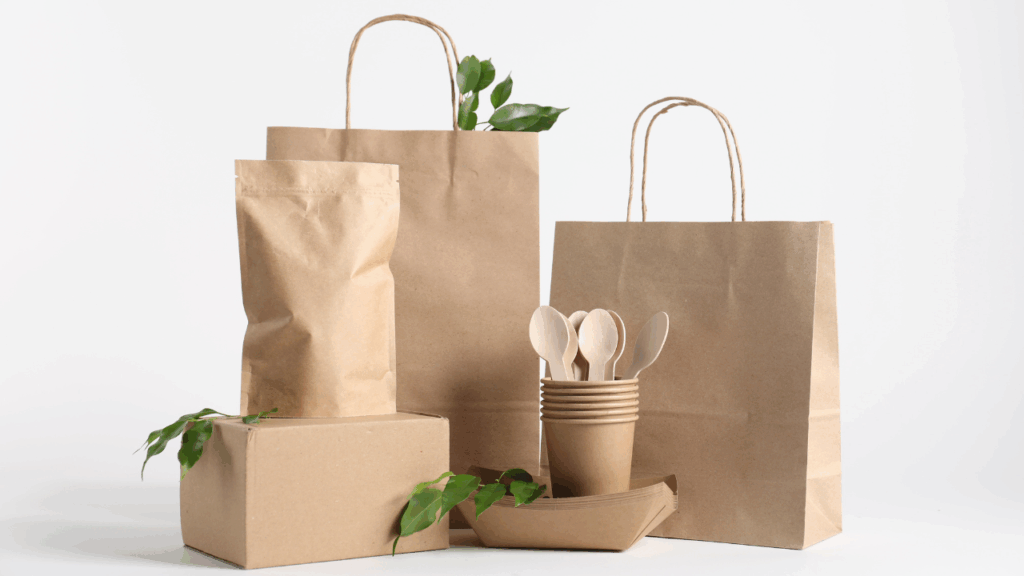
Market data, recycling rates, consumer behavior, and regulation, sourced throughout. 13.3% of U.S. plastic packaging actually gets recycled today, a figure unchanged since 2018. Brand intent, consumer preference, and market growth all point toward sustainability, but material recovery has not kept pace. The data below shows where that gap is widest, and where it is closing. Source: U.S. Plastics Pact, 2024–25 Impact Report
01 / Market Size
Sustainable packaging is a $300 to $400 billion global market, and it is growing faster than the packaging industry overall. Estimates vary by research firm depending on scope and methodology, but every major forecast points the same direction: regulation, brand commitments, and e-commerce volume are pulling capital into circular packaging solutions.
$325.94B Global sustainable packaging market value in 2026, projected to reach $463.41B by 2031 at a 7.29% CAGR.
Source: Mordor Intelligence, 2026
$399.97B Alternate 2026 estimate under a different scope model, projected to reach $671.97B by 2034.
Source: Fortune Business Insights, 2026
12.32% CAGR Growth rate of the compostable and biodegradable packaging segment through 2031, the fastest-growing category by process type.
Source: Mordor Intelligence, 2026
34% Share of the global market held by Europe, the largest region, ahead of North America.
Source: Mordor Intelligence, 2026
02 / Consumer Behavior
Shoppers say sustainability matters, but the premium they will actually pay is smaller than headline figures suggest. Two credible 2025 surveys, asking the question differently, produced very different-looking numbers. Both are accurate; read together, they show sustainability as a real but secondary purchase driver.
54% of U.S. consumers deliberately chose a product for its sustainable packaging in the past six months.
90% say they are more likely to buy from a brand or retailer whose packaging is eco-friendly.
39% have switched to a competing brand specifically because it offered more sustainable packaging.
43% of consumers are willing to pay some premium for sustainable packaging.
Source: Shorr Packaging, 2025 Sustainable Packaging Consumer Report
13% of U.S. consumers say they would pay “a lot more,” not just somewhat more, for sustainable packaging, a much smaller figure than general willingness-to-pay surveys.
Source: McKinsey Global Packaging Survey, 2025
Willingness to pay more, by generation
• Gen Z: 49%
• Millennials: 47%
• Gen X: 41%
• Baby Boomers: 37%
Source: Shorr Packaging, 2025
One more caveat worth knowing: McKinsey’s research also found that when shoppers rank what matters most at the point of purchase, food safety and shelf life outrank environmental impact in 10 of the 11 countries surveyed. Packaging still has to perform first.
03 / Recovery Rates
Not all “recyclable” materials recycle at the same rate. This is the gap that matters most for anyone choosing packaging materials: fiber-based packaging recovers at three to ten times the rate of the plastic films used in most mailers.
| Material | Recovery rate | Source |
| Corrugated cardboard | 69–74% | AF&PA, 2024 |
| Paper, overall | 60–64% | AF&PA, 2024 |
| HDPE bottles | 29.3% | US EPA |
| PET bottles & jars | 29.1% | US EPA |
| All U.S. plastic packaging | 13.3% | US Plastics Pact, 2024–25 |
| Plastic bags & film (mailer category) | ~5% (down from 9% in 2018) | US Plastics Pact |
| LDPE / LLDPE (poly mailer resin) | 2% (88% to landfill) | US Plastics Pact |
This is why brands weighing a Custom Poly Mailer against a fiber-based option should look past the word “recyclable” on the label and check which stream the material actually recovers in at scale.
04 / E-Commerce & Mailer Materials
Global parcel volume passed 167 billion shipments in 2023 and was tracking toward 200 billion by the end of 2025. Corrugated boxes, poly mailers, and padded mailers now cover more than 80% of all e-commerce shipments, which makes mailer material one of the highest-leverage sustainability choices a direct-to-consumer brand makes.
67% of online shoppers under 40 factor sustainable fulfillment into brand preference.
Source: NielsenIQ, cited via Atomix Logistics, 2026
$950.5M projected 2034 value of the compostable mailer market, up from $501.6M in 2024, a 6.6% CAGR.
Source: Future Market Insights, 2024
80%+ of e-commerce shipments are covered by corrugated, poly, and padded mailers combined.
Source: Atomix Logistics, 2026
Compare mailer materials against the data
Each material trades off differently between cost, protection, and real-world recovery. Here is how the five most common shipping mailer types stack up.
Paper Mailers 60–64% recovery rate
Enters one of the most established recycling streams in the U.S. Heavier and less water-resistant than film, but the material genuinely gets recovered.
Paper Padded Mailers 60–64% recovery rate
Fiber-based cushioning for fragile items, without the film-recycling caveats that come with bubble lining.
Compostable Mailers 6.6% category CAGR
The fastest-growing mailer segment. Works best where customers have real access to industrial or home composting.
Custom Poly Mailers ~2% real recovery rate
Lightest and lowest-cost option per shipment. Technically recyclable through store drop-off, but the LDPE/LLDPE resin recovers at close to the bottom of the packaging spectrum.
Bubble Mailers ~2% real recovery rate
Best cushioning-per-ounce for fragile items shipped in film. Carries the same recycling caveat as standard poly mailers.
05 / Regulation
Extended Producer Responsibility (EPR) laws now attach real fees and penalties to packaging material choices. Sustainability claims are becoming legal obligations, not marketing choices.
Enacted EPR packaging law
California, Colorado, Maine, Maryland, Minnesota, Oregon, Washington
Pending legislation
Hawaii, Illinois, New York, New Jersey
$50,000 maximum penalty per day, per violation, for EPR noncompliance in California and Oregon, the two states enforcing the steepest fees.
Oregon’s 2026 fee schedule ranges from $0 per pound for non-consumer corrugated cardboard to more than $1.30 per pound for certain plastic containers and foamed cushioning, a direct financial incentive toward fiber-based packaging.
Internationally, the EU’s Packaging and Packaging Waste Regulation (PPWR) becomes directly applicable across all member states on August 12, 2026, adding recyclability, reuse, and PFAS-ban requirements that affect any brand shipping into Europe.
06 / Global Context
Packaging decisions sit inside a much larger plastic production story. This is the backdrop that regulators and consumers are reacting to.
400 million tonnes of plastic produced globally per year as of 2024, up from 1.5 million tonnes in 1950.
Source: OECD Global Plastics Outlook
35% of all plastic produced globally goes into packaging.
Source: OECD, Global Plastics Outlook
22 million tonnes of plastic leaked into the environment in 2019 alone, the most recent full accounting.
Source: OECD, Global Plastics Outlook
1.23 billion tonnes projected global plastic waste by 2060, nearly triple the 460 million tonnes generated in 2019, absent policy change.
Source: OECD, Global Plastics Outlook
Frequently Asked Questions
What is the actual recycling rate of plastic packaging in the U.S.?
13.3%, according to the U.S. Plastics Pact’s most recent Impact Report. That figure has stayed essentially flat since 2018.
Are poly mailers recyclable?
Technically, through store drop-off film recycling programs. In practice, the LDPE and LLDPE resins used in most poly mailers recover at roughly 2%, with the large majority going to landfill.
Which packaging material recycles best?
Corrugated cardboard, at 69–74% recovery in 2024 U.S. data from the American Forest & Paper Association, one of the best-performing packaging materials in the country.
Will consumers actually pay more for sustainable packaging?
It depends on how the question is asked. 43% will pay some premium according to Shorr’s 2025 survey, while only 13% will pay “a lot more” according to McKinsey’s 2025 global survey. Both are correct; they are measuring different thresholds.
Are compostable mailers a good default choice?
Only where customers have real access to composting infrastructure. Most U.S. households do not, and compostable mailers can contaminate standard plastic recycling streams if they end up there instead.
Sources Cited on This Page
• U.S. EPA / Containers and Packaging: Product-Specific Data
• U.S. Plastics Pact / 2024–25 Impact Report
• American Forest & Paper Association / 2024 Recycling Rates
• Shorr Packaging / 2025 Sustainable Packaging Consumer Report
• McKinsey & Company / Sustainability in Packaging 2025
• Mordor Intelligence / Sustainable Packaging Market, 2026
• Fortune Business Insights / Sustainable Packaging Market, 2026
• OECD / Global Plastics Outlook
• Future Market Insights / Compostable Mailer Market, 2024
• Atomix Logistics / eCommerce Packaging Guide, 2026 (cites NielsenIQ, 2025)
• Woola / Online Shopping Packaging Waste Statistics, 2025
• Proskauer / Extended Producer Responsibility Packaging Law Update, 2026