


Direct-to-consumer is a business model where a brand sells its products straight to the end customer, with no wholesaler, distributor, or retailer standing in between. No middleman marking things up. No retail buyer deciding whether your product gets shelf space this season. Just the brand and the customer.
Retail as we knew it has been shrinking for years, and e-commerce is a big part of why. That shift has opened the door for D2C to grow fast, and it’s changed what business owners are able to build. Instead of shaping a product line around what a big-box retailer will agree to stock, brands can build something their actual customers want, and sell it to them directly.
It isn’t all upside, though. Cutting out the middleman also means cutting out everything that middleman used to handle quietly in the background, customer acquisition, fulfillment, and yes, packaging. This guide walks through what D2C actually means, why so many brands are moving toward it, the challenges that come with it, and why packaging turns into one of the most important decisions a D2C brand makes.
What Does D2C Mean?
D2C stands for direct-to-consumer. At its simplest, it means a brand sells directly to the people who use its products, instead of selling through a retailer.
Take a brand like Colgate. When you need toothpaste, you don’t go to a Colgate store, you buy it at Target or a grocery store down the street. That’s the traditional model most physical products still follow, and for most of the last century, it was close to the only option a brand had for reaching customers at scale.
Online selling changed that. A D2C brand builds its own e-commerce storefront, where customers discover the product, learn about it, buy it, and interact with the brand directly, without a retailer standing in the middle of that relationship.
The growth here has been substantial. US D2C e-commerce sales were estimated at roughly $212 to $240 billion in 2025 depending on the data source, and current projections put the global D2C market somewhere in the $300 billion range for 2026. However you slice the numbers, the direction is the same: more brands are building direct channels every year, and more consumers are comfortable buying that way.
Why Brands Are Choosing the D2C Model
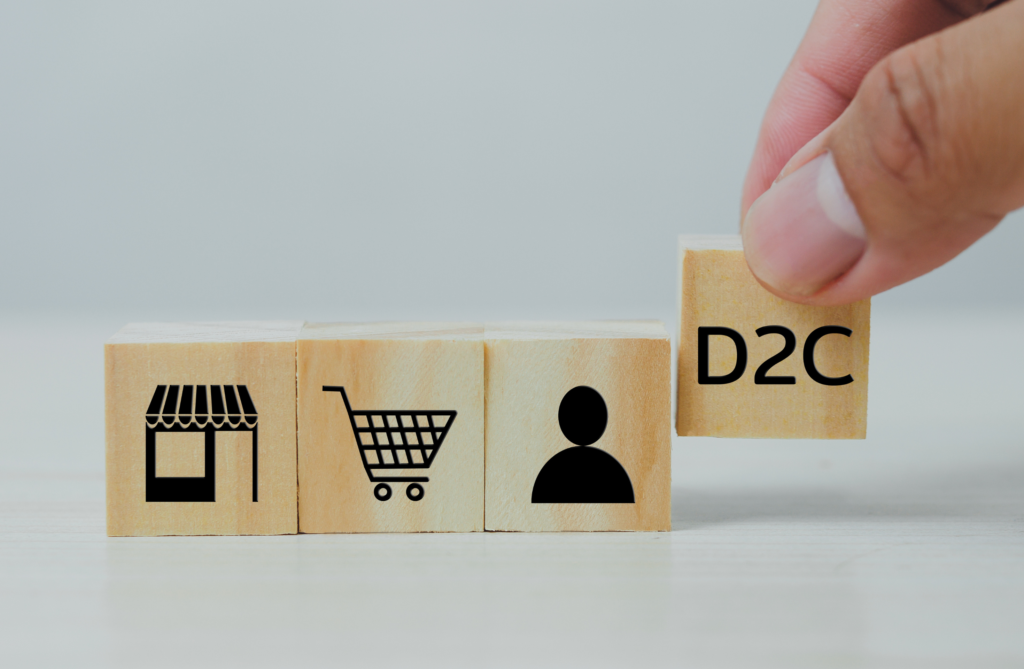
Going direct hands a brand a level of control over its product, pricing, and customer relationship that selling through a retailer simply doesn’t allow. Here’s what’s driving the shift.
Growing Consumer Demand
A large share of Gen Z shoppers now buy directly from brand websites rather than retailers, driven in large part by product discovery on TikTok and other social platforms. Retailers used to be a necessity for reaching customers at scale. Increasingly, for a lot of shoppers, they’re becoming an extra step rather than a requirement.
Higher Gross Margins
In the traditional model, a brand sells to a retailer, and the retailer marks the product up 50 to 100% before it reaches the customer. If a product sells for $10 through a retailer, the brand might collect $5 of that. Sell the same product directly, and the brand can price it at $7.50, still cheaper for the customer, while keeping a larger share of every sale. That gap alone is often the biggest financial argument for going direct.
More Control Over Pricing
Selling through a retailer means pricing changes go through negotiation and approval on their timeline, not yours. Selling direct means a brand can run a flash sale, bundle in a free gift, or adjust pricing on a slow-moving product the same day it notices a problem. Pricing becomes a lever a brand can actually pull, not just a number set once a year.
Selling the Brand Story, Not Just the Label
On a shelf, a product sits next to its competitors, and a shopper decides in seconds based on packaging and price. On a brand’s own website, that same shopper’s attention belongs to the brand for as long as they choose to hold it, long enough to tell a real story about sourcing, values, or what makes the product different. That matters more than ever given how much sustainability now factors into buying decisions. Recent industry surveys put the number of consumers willing to pay more for sustainably produced goods at around 80%, and separate research on packaging specifically found that roughly 90% of consumers say they’re more likely to buy from a brand with sustainable packaging. If a brand has a real sustainability story, a D2C setup is where that story actually gets heard.
More Control Over Packaging
Retail packaging often has to satisfy a retailer’s shelving and merchandising rules, sometimes down to a specific bag type a category buyer expects to see. Selling direct removes that constraint almost entirely. A brand shipping its own orders can choose exactly what a customer’s first physical impression looks like, whether that’s a fully recycled poly mailer or a plastic-free compostable mailer, rather than whatever a retailer’s category requirements dictate. Regulators are pushing in the same direction. As plastic taxes and Extended Producer Responsibility rules spread across more states and countries, brands that get ahead of these requirements now are the ones that won’t be scrambling to redesign packaging later.
More Agility to Test and Iterate
Getting a new product onto a retailer’s shelf takes months of pitching, negotiating, and committing to inventory before a brand even knows if it’ll sell. A D2C brand can list a small batch, watch how it performs, gather direct feedback, and adjust within weeks. The same goes for testing new services, like adding a buy-now-pay-later option or a subscription model, moves that are simply not available when a retailer sits between a brand and its customer.
Direct Access to Customer Data
Selling through a retailer usually means never knowing who actually bought your product. Selling direct means every purchase, every abandoned cart, and every repeat customer becomes data the brand owns outright. That data feeds back into better products, sharper marketing, and a website that actually improves over time instead of staying static.
The Challenges of Selling Direct-to-Consumer
If D2C is this advantageous, the obvious question is why every brand hasn’t made the switch. The honest answer: it’s a lot more work than it looks like from the outside.
Customer Acquisition
Selling through a retailer means the retailer has already done the work of getting shoppers in the door, online or in person. A brand still has to market itself to stand out, but the foot traffic exists before it does anything.
Go direct, and that traffic has to be built from zero. D2C brands typically pull customers in through a mix of channels:
- Organic search and SEO, which drives free, compounding traffic over time but takes real work to build
- Social media, where a large share of Gen Z shoppers say a platform post directly influenced a purchase, TikTok especially
- Influencer partnerships, which borrow an audience a brand hasn’t built on its own yet
- Paid advertising across Meta, Google, and other platforms, quantifiable but increasingly expensive as more brands compete for the same attention
Customer acquisition costs have climbed sharply over the past few years, industry benchmarks now put average e-commerce CAC somewhere between $45 and $85 depending on category, up significantly from just a few years ago. That’s before a single order ships.
Product Distribution and Fulfillment
Selling through a retailer means shipping in bulk to their distribution centers and letting them handle the rest, storefront display, checkout, and often returns. Go D2C, and every one of those steps becomes the brand’s own job: receiving inventory, storing it, picking and packing individual orders, and managing every return and exchange that comes back the other way.
This is where operations get genuinely harder, and it’s also where packaging choices start affecting the bottom line directly. A torn mailer or a crushed corner isn’t the retailer’s problem anymore, it’s a refund, a reshipment, and a support ticket that lands squarely on the brand. Some D2C brands lean on third-party logistics partners to handle this workload, though even then, packaging decisions still shape cost and damage rates either way.
Scalability
A retailer places one large, predictable purchase order. A D2C brand fulfills one unpredictable order at a time, which makes it much harder to capture the economies of scale that come with bulk manufacturing and bulk shipping supplies, packaging included. Early on, that often means higher per-unit costs across the board until order volume catches up.
Running everything in-house, the website, marketing, fulfillment, customer service, is a lot for a small team to carry at once. This is exactly where a lot of new D2C brands underestimate how much operational weight they’re taking on by skipping the retailer.
Where Packaging Fits Into a D2C Strategy
For most D2C companies, the box or mailer that lands on a customer’s doorstep is the very first physical touchpoint with the brand. That makes it one of the highest-leverage decisions in the entire operation, not a line item to minimize.
At Plus Packaging, this is the exact problem we help D2C brands solve.
- Materials that hold up to real scrutiny. Vague “eco-friendly” language doesn’t hold up anymore, not when a large share of shoppers say they won’t trust a sustainability claim without something to back it up. We work in recycled content, genuinely compostable films, and standard materials, matched to what a brand can actually stand behind.
- A format for every kind of product and shipping need. Some brands need a rigid box. Others want to go fully plastic-free. Others need the lightest possible mailer to keep shipping costs down on apparel or soft goods. Between poly mailers, paper mailers, bubble mailers, compostable mailers, and paper padded mailers, there’s a format built for nearly every product type and price point.
- Full custom branding. Logo, color, pattern, and finish across the entire mailer or box, not just a sticker slapped on a plain bag. That’s what turns an ordinary delivery into something a customer photographs and shares.
- Support that goes past the first order. Packaging decisions get more complicated as a brand scales, new SKUs, new sizes, new sustainability requirements, new markets. Our team stays involved well past the initial purchase, not just for the first order.
We go deeper on how to actually choose between these materials and formats in our guide to sustainable packaging materials, and if poly mailers specifically are the right fit for your product, our interview with our poly mailer experts covers pricing, sizing, and lead times in detail.
D2C Brands Getting Packaging Right
Allbirds
Allbirds built its entire brand identity around sustainable materials, from the wool and eucalyptus fiber in its shoes to the packaging that ships them. That consistency, sustainability showing up in the product and the box, not just the marketing copy, is a big part of why the brand’s environmental positioning has stayed credible with customers for years.
Glossier
Glossier turned packaging into a genuine piece of brand identity rather than an afterthought. Its distinctive pink pouch became something customers photographed and posted online without being asked to, effectively turning a shipping bag into free marketing. It’s a clear example of what happens when a D2C brand treats the unboxing moment as part of the product experience instead of just a delivery mechanism.
Ritual
Ritual, a subscription vitamin and supplement brand, ships smaller orders in a recycled padded mailer built specifically to protect its glass bottles and pill-based products without needing a full shipping box. That choice keeps shipping weight and cost down while still holding up in transit, exactly the kind of trade-off a D2C brand has to get right when it owns fulfillment end to end.
The pattern across all three: none of them treated packaging as a place to cut corners. They treated it as a brand touchpoint worth investing in, and it’s shown up directly in customer loyalty and word-of-mouth marketing that a retail shelf placement never could have delivered.
Start Your D2C Packaging Strategy
Direct-to-consumer selling gives a brand control over pricing, story, and customer relationships that a retail partnership never could. It also hands over responsibilities a retailer used to quietly absorb, and packaging is one of the biggest ones a brand takes on the moment it starts shipping direct.
Plus Packaging works with D2C brands to find the right mailer or box for their product, order volume, and sustainability goals, whether that’s a custom poly mailer for a fast-growing apparel line, a custom bubble mailer for something fragile, or a custom compostable mailer for a brand built around an eco-conscious customer base. Get in touch, and we’ll help you build a packaging strategy that scales with your business instead of holding it back.